Je winkelwagen is nog leeg



The benefits of grounded sleeping sound appealing, but sleeping grounded is not a proven solution for sleep problems. You may well recognise the confusion: one person's experience sounds promising, whilst you wonder what research genuinely demonstrates. The honest answer is that potential benefits remain uncertain.
Small exploratory studies have investigated sleep and grounding. Some people report feeling more refreshed, but such personal accounts do not prove that grounding caused the change. The research is limited and does not provide a robust basis for recommending grounding as a treatment.
In this article, you will learn what grounded sleeping entails, which potential benefits have been researched, and where uncertainty remains. You will also find practical tips on trying it out calmly, for example by adding a grounding sheet to your bedtime routine. This helps you keep your expectations realistic and decide for yourself whether it fits into your routine.
A grounding sheet on your bed quickly raises questions: can such a straightforward addition truly change your night's rest? Grounded sleeping means using a grounding product whilst sleeping that is designed to replicate direct contact with the earth. The practice is also called grounding or earthing. These are closely related terms, but a proposed mechanism is not the same as a proven effect. It is therefore wise to examine the benefits of grounded sleeping claim by claim.
Outdoor earthing can be done, for example, by standing barefoot on grass or soil. Indoors, you use a grounding product as a practical way to replicate that contact during rest or sleep. A grounding sheet is a sheet designed for this purpose. Using one adds an element to your sleep routine, but does not guarantee that you will fall asleep faster or wake up feeling more refreshed.
Users and suppliers attribute various benefits to grounding. When it comes to sleep, these mainly focus on improved perceived sleep quality, deeper sleep, and greater relaxation. Such experiences can be personally meaningful, but they do not prove that grounding is the underlying cause. Expectations, adjustments in habits, and other circumstances may also play a role. Below, we look separately at what research on sleep actually reveals and where uncertainty persists.
Reports concerning reduced snoring or improvements in sleep apnoea also call for caution. A personal account does not prove that a grounding product reduces snoring or apnoea. It should never serve as a reason to replace medical investigation or treatment for breathing difficulties during sleep. Always discuss such symptoms with a healthcare professional.
Grounding is sometimes situated within broader concepts of alternative medicine. An overview of criticism of grounded sleeping also outlines the scepticism from the medical community towards earthing. This makes it all the more essential not to confuse attributed benefits with proven sleep therapies.
Attributed benefits such as deeper sleep and relaxation are experiences or claims, not proven sleep therapies. This nuance does not rule out curiosity. Rather, it helps you view grounded sleeping as a potential addition to your routine, rather than a guaranteed solution for restless nights.
An explanation can sound biologically plausible without proving that it actually helps you sleep better. This distinction is vital when discussing grounding. Proponents describe a possible interaction between the human body and the earth; researchers must then determine whether that interaction yields measurable changes in sleep.
According to the proposed explanation, contact with the earth may facilitate the transfer of electrons into the body. Advocates suggest that these electrons can neutralise free radicals and thereby influence inflammatory processes. This is a hypothesis about how grounding might operate, not an established pathway to a better night's rest. Even a measured biological change does not automatically demonstrate that someone falls asleep more easily or wakes up feeling more restored.
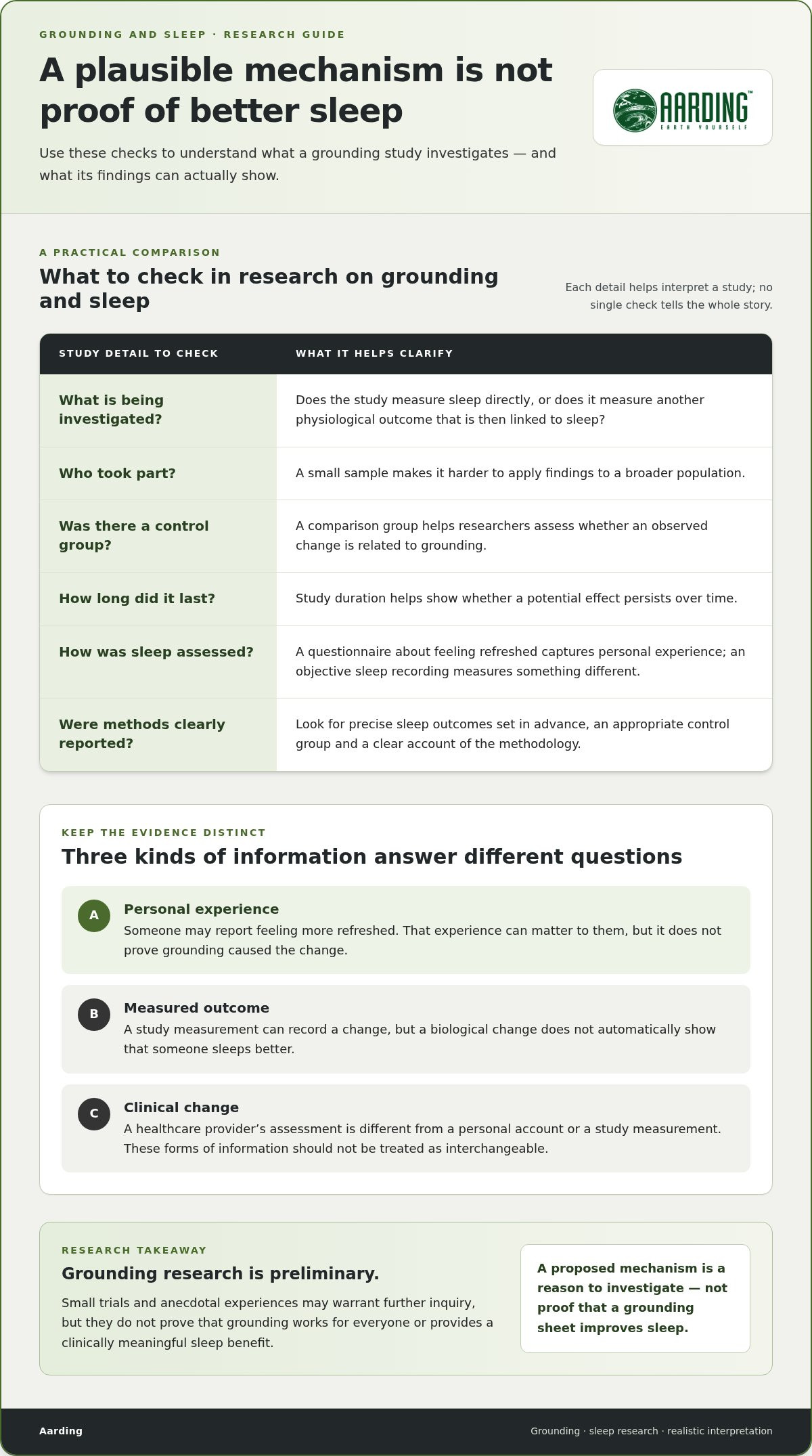
First, consider what a study actually investigates. Does it measure sleep directly, or does it assess another physiological outcome that is subsequently linked to sleep? Study design also matters. A small sample size makes findings less applicable to a broader population. A control group helps determine whether an observed change is truly related to grounding. Study duration provides insight into whether any potential effect persists over time.
Pay close attention to measurement methods as well. A questionnaire about how refreshed participants feel can capture meaningful experiences, but it differs fundamentally from an objective sleep recording. No single measurement method tells the entire story. The clearest picture emerges when researchers establish precise sleep outcomes in advance, compare participants against an appropriate control group, and meticulously report their methodology.
Research into grounding is generally characterised as preliminary. Small trials and anecdotal experiences may warrant further inquiry, but they do not prove that the approach works for everyone or delivers a clinically meaningful sleep benefit. When reviewing a specific study, check who participated, how long it lasted, exactly what was measured, and whether a comparison group was included. Without this information, definitive conclusions are unwarranted.
A plausible biological mechanism is a reason for further research, not proof that grounding improves sleep. The same holds true for attributed benefits of grounded sleeping: a change experienced by an individual is not automatically a proven therapy or the direct result of grounding. Keep this distinction in mind when reading scientific papers, and consider a grounding product at most as a potential complement to your routine. Browse the various grounding products for restful moments without anticipating a specific outcome in advance.
When considering claims regarding sleep, it is helpful to distinguish between three types of information: how someone experiences their night's rest, what a measurement device registers, and whether a healthcare provider identifies a medical change. These data points answer entirely different questions. Feeling better upon waking can be meaningful, but on its own it does not prove that your sleep objectively altered or that grounding was responsible.
Research can measure parameters such as sleep duration, nocturnal awakenings, or perceived sleep quality. Small-scale trials and questionnaires have noted subjective improvements in sleep experience, but this falls short of robust proof that grounding improves sleep generally. Furthermore, a subjective questionnaire measures something distinct from objective sleep monitoring. Even a statistically significant shift does not automatically mean it is clinically meaningful.
Study design dictates how far conclusions can reasonably reach. Small participant cohorts, short intervention periods, or the lack of an adequate control group make it difficult to exclude placebo effects, expectations, and other routine adjustments. A review of studies can highlight broader patterns, but it cannot eliminate the methodological shortcomings of individual papers. Based on current preliminary evidence, one cannot conclude that grounding treats insomnia, snoring, or sleep apnoea.
| Claim | What is known | What uncertainty remains |
|---|---|---|
| Improved perceived sleep quality | Participants in small-scale studies and users occasionally report sleeping better. | Experience alone does not demonstrate causation; expectations and other lifestyle changes may be involved. |
| Longer or deeper sleep | Sleep duration and sleep architecture are outcomes that clinical studies can monitor. | A subjective impression is not an objective measurement; findings from limited trials cannot simply be generalised to everyone. |
| Greater relaxation before bed | Some users state that they feel calmer and more relaxed. | A consistent evening routine and psychological expectations can equally influence this experience. |
Personal experiences describe individual perception, but they do not constitute scientific evidence in themselves. A calmer feeling might coincide with a more mindful bedtime ritual, without it being clear which component explains the shift. For persistent sleep issues, seeking appropriate professional guidance is far wiser than relying on a grounding product as a treatment.
Experiences with grounded sleeping vary from person to person, and a specific sleep outcome is never guaranteed. View reported benefits of grounded sleeping as claims to weigh up carefully, rather than established facts.
If you wish to try grounded sleeping, do not start by asking whether it will work immediately. First, map out your current sleep patterns. This allows you to observe changes without instantly attributing every good or restless night to the product. There is no set trial period or guaranteed outcome. The aim is to observe calmly and see whether the practice aligns with your lifestyle.
A grounding sheet, often crafted from soft organic cotton with conductive fibres, is designed for use on your bed. Always follow the product instructions provided and do not alter the setup on your own initiative. Keep your regular bedtime, evening habits, and sleep environment as consistent as possible. If you change multiple habits simultaneously, it becomes far harder to discern what might be linked to a shift in your sleep.
Make a brief note beforehand of your routine and expectations. For instance, write down how refreshed you feel in the morning, whether you woke up during the night, and how relaxed you felt before switching off the lights. Record your observations without aiming for a preconceived result. A handful of fluctuating nights will not provide an immediate, clear picture.
The choice largely depends on when and where you wish to introduce grounding into your routine. A grounding mat may be suited to a moment of rest away from your bed, such as at a desk or whilst reading. A sheet is designed specifically for overnight use. A grounding blanket or a pillowcase offers another practical option. Make your selection based on your preference and comfort, rather than promises of a specific therapeutic outcome.
A straightforward approach:
Do not alter any medical treatment or prescribed care for sleep conditions in favour of a grounding product. If symptoms persist or interfere with your daily life, discuss them with a healthcare professional. Grounding can serve at most as a personal lifestyle addition, never as a substitute for appropriate medical care. Explore the range of grounding products for sleep and rest to discover which formats suit your downtime.
Grounding products offer a practical way to integrate grounded sleeping into your existing bedtime routine. Their role is simple: they are tools to facilitate grounding, not a medical remedy and not a guarantee of better sleep. Which format suits you best depends on where and how you intend to use it. The potential benefits of grounded sleeping remain unproven and vary between individuals.
If you want to add grounding to your nighttime routine, a grounding sheet is a natural place to start. A half sheet provides an alternative if you prefer not to cover the entire mattress. A grounding blanket, pillowcase, or sleep mat provides another format to consider alongside your standard bedding. Choose according to where and when you wish to use the product, and always adhere to the supplied instructions.
There is no need to overhaul your entire bedroom setup at once. Consider what feels practical: would you prefer an integrated sheet on your bed, or does a separate grounding mat suit your relaxation habits better? The product format reflects its practical application, not a guaranteed effect on sleep onset, sleep depth, or physical recovery.
Testing a product is an individual choice. Do not expect identical results every night. You can keep a log of your experiences, but sleep is influenced by countless lifestyle and environmental factors. A more restful night is always welcome, but it does not prove on its own that the product was responsible. Conversely, noticing no discernible difference does not mean you are doing anything wrong.
Do not rely on grounding products as a substitute for professional clinical advice if sleep issues persist or disrupt your daily functioning. A grounding sheet, grounding blanket, pillowcase, half sheet, or sleep mat cannot treat a diagnosed sleep disorder. Discuss ongoing concerns with a doctor and follow established medical advice.
Select the product format that complements your sleep habits and fits comfortably into your lifestyle, without anticipating guaranteed health improvements. Looking to explore the available options at your own pace? Discover Aarding grounding products and see which format complements your moments of rest. Individual experiences and outcomes will always differ.
At present, grounded sleeping is primarily an accessible way to introduce grounding into your periods of rest, rather than a clinically proven treatment for sleep disturbances. The benefits of grounded sleeping are often associated with perceived sleep quality and relaxation, but scientific studies have not yet established certainty regarding causation, efficacy, or universal outcomes.
If you wish to test it for yourself, begin by assessing your current sleep habits and expectations. Keep your routine as steady as possible and observe how you feel, without treating a single night as definitive proof. Persistent symptoms warrant professional medical attention; a grounding product cannot replace this.
At Aarding, you will find grounding sheets for single and double beds, alongside grounding blankets, pillowcases, sleep mats, and versatile grounding mats. Select a format tailored to how and when you wish to use it in your routine. Discover Aarding grounding products and explore at your leisure what fits your lifestyle. Maintain realistic expectations and allow yourself the space to discover what feels comfortable.
Grounded sleeping is often associated with improved perceived sleep quality, deeper rest, and enhanced relaxation. Some individuals report feeling more revitalised, but such anecdotes cannot predict what you will experience, nor do they prove that grounding is responsible. The benefits of grounded sleeping have not been conclusively established by science. Therefore, do not regard grounding as a treatment for insomnia or other sleep disorders, but at most as a personal lifestyle addition.
No, grounded sleeping has not been conclusively proven as an effective method for improving sleep. While scientific studies into grounding exist, many investigated endpoints do not assess sleep directly. Consider sample sizes, the presence of control groups, and precisely what parameters were recorded. While a proposed biological mechanism may sound intriguing, it does not constitute clinical proof of better sleep. Always evaluate scientific claims with healthy discernment.
A grounding sheet is designed to facilitate grounding conveniently during the night, but it cannot guarantee better rest. Some users report a more comfortable sleep experience, whilst others notice no difference whatsoever. Assess research into sleep benefits by examining the measurement techniques and overall study quality. When trying a sheet, keep your general sleep hygiene consistent and never treat the product as an alternative to healthy lifestyle habits or medical care.
Use the grounding sheet strictly according to the manufacturer's instructions. If you want to evaluate whether you notice any change, record your typical bedtime and morning energy levels beforehand. Keep other sleep habits as uniform as possible to evaluate any differences fairly. Do not anticipate an immediate, guaranteed effect, and never discontinue prescribed medical care based on personal impressions.
There is no established timeframe within which everyone can expect to notice an effect. Sleep naturally varies from night to night and is readily influenced by stress, diet, and routine changes. You can keep a sleep diary to monitor your rest, but avoid drawing firm conclusions from a single night or brief trial. An individual difference does not establish that grounding was the cause.
No, a grounding product cannot replace professional clinical evaluation or treatment for persistent or severe sleep disorders. The potential effects of grounding remain scientifically uncertain, and symptom relief is not guaranteed. Regard any product strictly as a personal lifestyle complement, never as a medical solution. Consult a qualified healthcare professional regarding long-standing complaints, particularly if they impair your daytime functioning. Never modify prescribed care based on product experiences.
Reacties worden goedgekeurd voordat ze verschijnen.