Je winkelwagen is nog leeg



What if the key to greater calm in your head does not lie in fighting the noise, but in soothing the nervous system that amplifies the signal? Many people wonder: can grounding help with tinnitus? When a persistent ringing or buzzing fills your days, it often leads to constant mental fatigue and disrupted nights. The frustration surrounding the lack of ready-made medical answers is understandable and entirely relatable.
Grounding is not a medical miracle cure that instantly switches tinnitus off. However, physical contact with the Earth via conductive materials made of silver fibre and organic cotton can help reduce accumulated stress, support sleep quality, and bring an overstimulated nervous system back into balance. In this article, you will discover how grounding can offer relief from tinnitus through stress reduction and deeper rest, what the science says about this, and how you can apply it simply and safely at home.
To understand whether and how physical discharge brings relief, we must first look at the source of the sound. Many people assume that tinnitus stems purely from damaged hair cells in the inner ear. Yet neurology paints a different picture: tinnitus originates largely within the brain. When the auditory organ transmits fewer signals, the auditory cortex attempts to compensate for this deficit by dialling up its internal sensitivity. This triggers spontaneous, hyperactive neural firing. What is tinnitus precisely on a physiological level? It is essentially a phantom auditory perception generated by hyperactive neural pathways.
The question can grounding help with tinnitus is intimately tied to the state of your autonomic nervous system. Chronic mental or physical strain throws this system off balance. As a result, the body remains stuck in a persistent state of alertness, prompting the brain to interpret the internal ringing as an imminent threat signal. This sharpens auditory focus, making the sound feel subjectively much louder and more intrusive. By intentionally fostering overall bodily rest, you help take the sharp edge off this sensory overload.
As soon as stress takes hold, the body activates its sympathetic fight-or-flight response. This mechanism immediately heightens sensory alertness within the auditory cortex. Furthermore, persistently elevated cortisol levels lead to unconscious muscle tension in the neck, jaw, and around the base of the skull. This somatic tension places extra strain on the nerve pathways leading to the auditory centre. The brain's natural filtering capacity becomes obstructed; your brain simply no longer manages to filter out the background noise.
To establish realistic expectations, a clear distinction between the two primary forms of tinnitus is essential:
When considering whether can grounding help with tinnitus, we focus specifically on the subjective variant. Grounding, facilitated by conductive silver fibre, is not a medical procedure for structural vascular defects. Rather, it serves as a lifestyle intervention aimed at soothing the sympathetic nervous system, allowing the brain to loosen its fixation on the acoustic phantom signal.
Physical grounding is rooted in a straightforward principle of physics. As soon as bare skin makes contact with the surface of the Earth, or indoors via a conductive system woven with silver fibre and organic cotton, a direct exchange of free electrons takes place. These negatively charged particles neutralise positively charged free radicals within tissues. Researchers recognise this mechanism as one that helps regulate oxidative stress and enhances microcirculation. Healthy blood flow and reduced blood viscosity support tissues throughout the entire body, including the auditory apparatus and neighbouring muscle groups.
When exploring whether can grounding help with tinnitus, the goal is not to seek a rapid magic bullet. It is about fostering a physiological environment in which your body can naturally settle into calm. Leading authorities that share reliable information on tinnitus routinely highlight that the perceived intensity of symptoms is closely interwoven with physical stress responses and overstimulation.
Persistent low-grade inflammation can covertly heighten the sensitivity of the nervous system. When tissues endure prolonged inflammatory stress, sensory nerve pathways react more swiftly and intensely to stimuli. By absorbing free electrons during grounding, cellular redox balance is supported. This restores calm within peripheral tissues. For those living with tinnitus, a reduction in this biological strain can mean that the neural pathways surrounding the auditory centre become less irritable.
Beyond inflammatory pathways, grounding exerts a direct influence on the vagus nerve, the primary driver of the parasympathetic nervous system. While tinnitus sufferers frequently find themselves trapped in a vicious cycle of alertness, grounding actively encourages the rest-and-digest mode. Biorhythm studies demonstrate that grounded resting helps stabilise a dysregulated 24-hour cortisol profile. When evening cortisol drops to a natural level, physiological vigilance declines. The brain no longer needs to maintain constant guard and can gradually release its focus on the ringing.
By establishing regular moments of rest on a grounding mat or relaxing beneath a grounding blanket, you offer your nervous system a potent reassurance of safety. If you would like to explore how this fits effortlessly into your evening routine, consider the possibilities of natural grounding for your home.
If we examine the question can grounding help with tinnitus from a strictly clinical standpoint, honest scientific nuance is warranted. At present, there are no large-scale, double-blind clinical trials evaluating grounding specifically as a standalone treatment for tinnitus. Scientific literature on grounding focuses primarily on indirect physiological pillars: deep sleep architecture, inflammatory markers, and autonomic nervous system regulation.
What sleep research does substantiate is that grounding assists in falling asleep faster and extends the duration of restorative slow-wave sleep. For someone coping with tinnitus, this indirect pathway is of immense value. When your nervous system is granted the opportunity to unwind deeply overnight, your daytime mental resilience improves substantially. As a consequence, the constant sound feels less dominant and draining. We therefore do not view grounding as a medical cure, but rather as a powerful lifestyle practice to fortify your innate resilience.
The moment the bedroom falls quiet, the ringing takes centre stage unchecked. This auditory focus triggers alertness, rendering restful sleep seemingly unattainable. The resulting sleep deficit subsequently lowers the threshold of irritability within the central nervous system. The following day, the brain registers the internal sound with even greater acuity. By sleeping on a conductive grounding sheet, you encourage the transition into the recovery phase, allowing this exhausting dynamic to ease step by step.
Individuals who consistently integrate a grounding sheet or grounding mat into their home routine report varied experiences. Maintaining a grounded perspective helps set realistic expectations:
Although a balanced sleep environment builds fortitude, a thorough clinical evaluation remains vital. When in doubt, always review guidance on when to consult a doctor or specialist to ensure underlying audiological conditions or cardiovascular factors are investigated in good time.
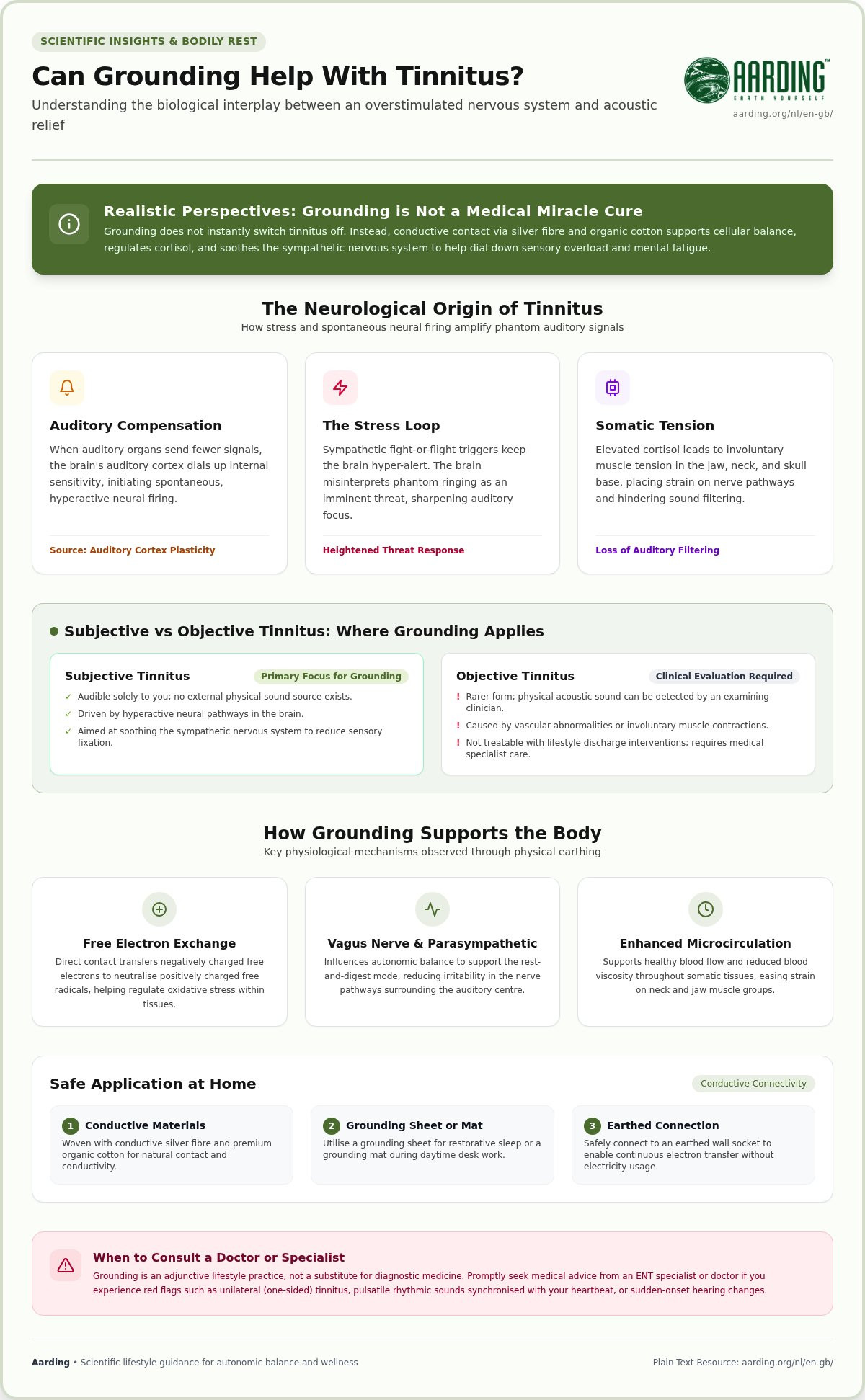
Safety and simplicity form the foundation of any responsible routine. Those wishing to experience how can grounding help with tinnitus should not begin with drastic changes, but with an unhurried integration into their living environment. Grounding products do not operate on mains electricity; they connect exclusively to the Earth wire via the earth pin or earthing contacts of a standard wall socket. A built-in resistor within the connection cord guarantees a thoroughly safe connection to the Earth.
To allow your body to adapt smoothly, follow these four practical steps:
The most effective approach depends on your daily schedule. An Earthing Fitted Sheet or Earthing Half Sheet crafted from organic cotton with finely woven silver fibre provides effortless, continuous relaxation throughout your sleep. During the day, the Universal Earthing Mat or Earthing Desk Mat is ideal beneath bare feet or palms while working at a desk. In this manner, your body discharges physical tension without requiring extra time out of your day.
Grounding performs at its best when part of a broader lifestyle designed to bring calm to the auditory system. Dim bright lights and avoid digital screens for at least an hour before bed to limit sensory overload. Try pairing your time on a grounding product with a calming breathing exercise, such as inhaling for four counts and exhaling smoothly for six counts. This immediately reinforces the parasympathetic recovery signal sent to the brain.
Curious to discover how can grounding help with tinnitus as part of your personal wellbeing routine? Explore the natural range at Aarding for premium conductive grounding products and experience for yourself what grounded sleep can offer your nervous system.
Natural self-care and grounding practices offer valuable soothing for an overstimulated nervous system, but they must never replace professional diagnostics. Tinnitus is fundamentally a cautionary signal from the body. At times, the sound points to an underlying medical condition requiring targeted clinical attention. ENT specialists and audiologists possess specialist diagnostic equipment to assess your hearing function precisely and detect physical anomalies promptly.
Evaluating whether can grounding help with tinnitus becomes genuinely relevant only after a medical professional has ruled out serious physical causes. A holistic approach functions best as a safe complement alongside clinical care, not as an alternative to necessary medical examinations.
Not every case of tinnitus develops gradually from long-term strain. Specific symptoms necessitate timely assessment by a GP or specialist:
A considered recovery path brings together the strengths of both worlds. Feel free to discuss complementary practices openly with your treating specialist. Many clinicians today recognise the immense value of stress management, consistent sleep quality, and relaxation methods in keeping auditory discomfort manageable. Sleeping grounded on an Earthing Fitted Sheet or resting on an Earthing Sleep Mat fits seamlessly alongside audiological rehabilitation, cognitive behavioural therapy, or sound-enrichment devices.
Those asking can grounding help with tinnitus often find the greatest benefit within this synergy. By coupling medical clarity with gentle lifestyle adaptations, you cultivate inner quiet. In doing so, you grant your nervous system the vital breathing room it needs to recover gradually from chronic alertness.
The answer to the question can grounding help with tinnitus does not lie in a rapid cure, but in systematically soothing the foundation: your autonomic nervous system. By easing chronic vigilance and encouraging natural deep sleep cycles, you help break the exhausting feedback loop wherein the brain continuously amplifies auditory signals. Once the body rediscovers physiological safety, space emerges for the brain to let the noise fade gently into the background.
With grounding products crafted from certified organic cotton and finely woven silver fibre, you can bring this connection into your bedroom safely and effortlessly via a standard earthed socket. Experience the calming effect on your nervous system firsthand with the premium products from Aarding. Give yourself the time and supportive setting required to rediscover deep relaxation and nighttime quiet step by step.
No, grounding is not a medical cure for hearing impairment or neurological conditions. Can grounding help with tinnitus? Primarily as a supportive method that brings calm to an overtaxed nervous system. By helping lower stress hormones and deepening nocturnal rest, it frequently reduces the subjective intensity and distress caused by the noise. Consider it a valuable lifestyle intervention to nurture your biological resilience, rather than an instant fix that switches the sound off.
This varies from person to person depending on the extent of chronic stress. Many individuals experience deeper sleep and greater physical relaxation within just a few nights. For shifts in tinnitus perception, consistency is crucial; strained neural pathways require time to rebalance. Allow for a period of two to four weeks of consistent, grounded sleep before assessing changes in auditory focus and muscular tension.
Yes, doing so is entirely safe and represents the most effective way to discharge tension. Products such as a grounding sheet made from organic cotton and silver fibre connect strictly to the earth pin of the wall socket, never to mains electricity. In addition, the connection lead incorporates an integrated safety resistor. Your body can safely draw upon free electrons throughout the night without any risk of electrical overload.
Without a functioning earth connection, a grounding product cannot function indoors, as there is no pathway to the Earth's surface. You can readily verify your socket beforehand using a socket tester. If your bedroom lacks earthed sockets, you can use an external earthing rod placed directly in the soil outside, or consult a qualified electrician to earth the socket safely.
In the first few days, some individuals notice mild tingling or transient shifts in sensory perception. As the autonomic nervous system shifts gears from sustained alertness towards rest, microcirculation in the cranial area adjusts. This can momentarily make the sound stand out more prominently. This sensation usually settles quickly. If you feel sensitive, begin gently with a grounding mat for an hour a day and increase usage gradually.
Walking barefoot outdoors on grass, soil, or wet sand relies on the exact same physical mechanism. The distinction is mainly practical: we rarely spend hours barefoot outside, especially during colder seasons. A grounding blanket or grounding sheet delivers the convenience of prolonged contact for seven to eight uninterrupted hours in bed, precisely when your cells and nervous system undergo restorative repair.
Special clothing is unnecessary, but direct skin contact with the material yields the best results. Thin nightwear made from natural fibres will permit conductivity after a short period due to ambient moisture, yet bare skin ensures immediate electron transfer. When using a grounding mat, simply rest your bare feet, hands, or forearms directly on the surface for optimum benefit.
Reacties worden goedgekeurd voordat ze verschijnen.