Je winkelwagen is nog leeg



Are you looking for a product for your sleep routine, a moment of relaxation, or your workspace? When it comes to earthing products in the Netherlands, making a suitable choice is not about the grandest promise, but about finding the product format that aligns with your daily routine and the information you can verify.
The names and applications can sometimes appear similar. A grounding sheet is a fitted sheet, whilst a grounding mat and a grounding blanket take different forms. Material specifications also require close attention: organic cotton does not indicate on its own which conductive materials have additionally been used or how the product has been constructed. Therefore, compare the product information for each individual item.
In this article, you will learn what earthing products are and how fitted sheets, half sheets, blankets, pillowcases, and mats differ from one another. You will discover what to look out for regarding usage, sizing, and material details. We also discuss what research into potential health effects does and does not show. This allows you to choose a product format that suits sleeping, relaxing, or working, with realistic expectations.
You will come across the words earthing and grounding in information regarding products intended for contact with the Earth. Here, they refer to a wellness concept, not a medical treatment. That distinction is important, as ‘earthing’ can also refer to electrical safety within a building. The context determines which meaning is intended.
Within the wellness concept, grounding refers to the idea of establishing a connection to the Earth through direct contact. Products designed for indoor use contain conductive materials intended to facilitate that connection. In product information, a fitted sheet may, for example, be called a grounding sheet, a mat a grounding mat, and a blanket a grounding blanket.
Earthing and grounding are terms that describe the concept of physical contact with the Earth. These terms indicate what a product is intended for, but they do not prove that it has a specific health effect. A description of the concept is therefore not a medical conclusion.
The same words can carry a different meaning in other contexts. For instance, the page on Earthing (alternative medicine) distinguishes between earthing as an alternative wellness practice and earthing in electrical engineering. You should therefore examine the product description and the context, rather than relying solely on the name.
Conductive materials can transfer electrical charge. In earthing products, they serve as a functional component: they are intended to enable contact between the user and the product within the grounding concept. That in itself says nothing about a health effect. The composition varies by product and cannot be deduced from a general category such as a fitted sheet or a mat.
Always read the material information for the specific product. Organic cotton is a material term, but it does not mean that every product is made from it or that it delivers a particular effect. Check which materials are actually listed and avoid inferring properties from a generic product overview. This helps you keep product characteristics separate from claims about efficacy.
When exploring earthing products in the Netherlands, this distinction helps you read product information carefully: the product name describes the concept or the format, whilst the material specification explains what the product is actually composed of according to its description. What a product aims to achieve and what research demonstrates regarding potential health effects are two separate questions. Those evidential boundaries warrant their own critical evaluation.
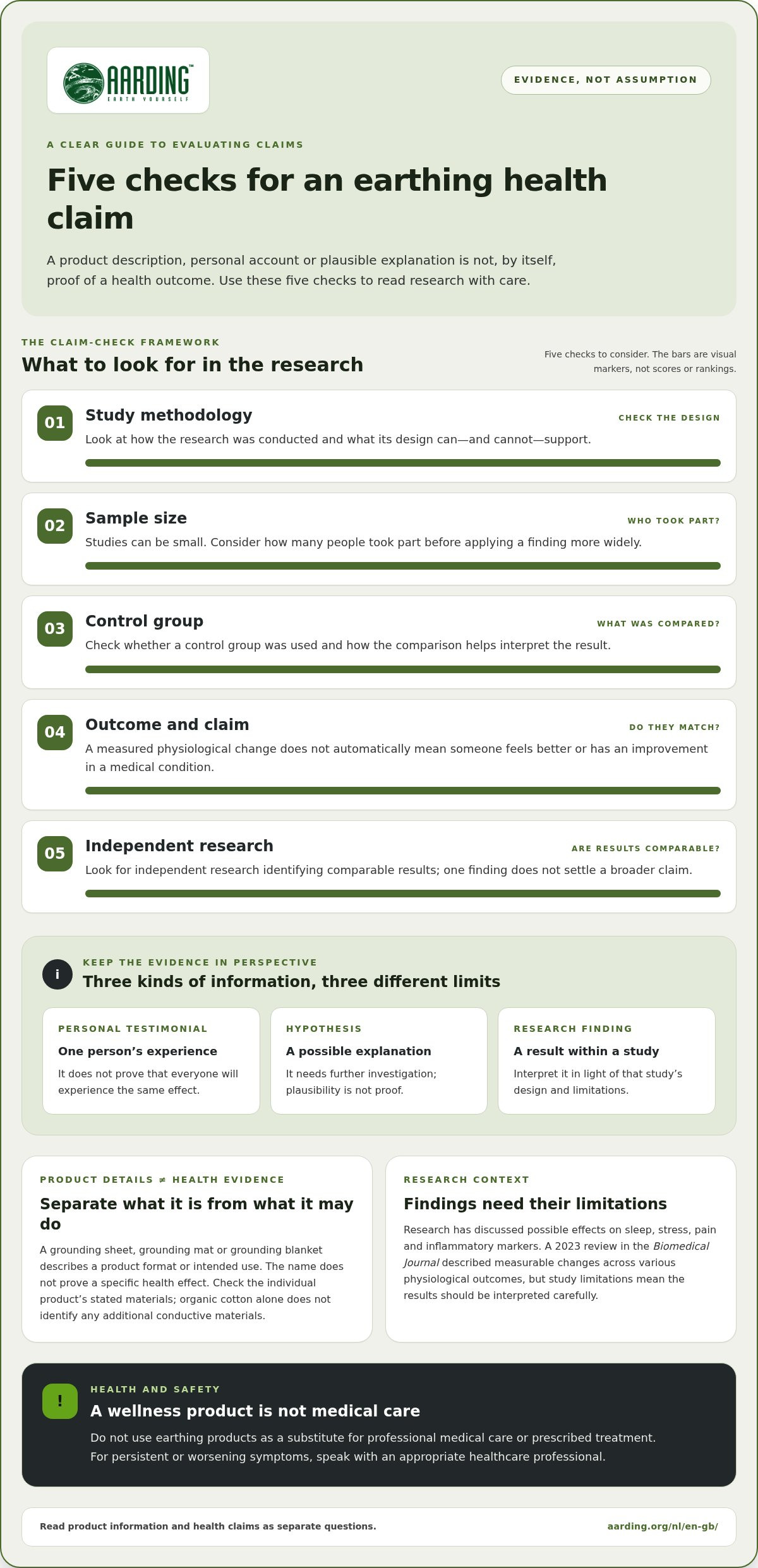
Personal experiences with grounding can help someone assess whether a product fits comfortably into a daily routine. However, a personal account—such as sleeping better after using a grounding sheet—does not prove that everyone will experience the same effect. Nor does a plausible explanation of how earthing might work prove that a product prevents or treats medical conditions.
Research into earthing has discussed potential effects on sleep, stress, pain, and inflammatory markers, amongst other parameters. A 2023 review in the Biomedical Journal described measurable changes across various physiological outcomes. Such findings warrant attention, yet they must be viewed alongside the limitations of the available research. Studies can be small, participants may be aware of the intervention they are using, and results are not automatically applicable to other groups or products.
A health claim requires more than an enthusiastic recommendation or a reference to a single study. Look closely at the research methodology, the sample size, the control group used, and whether the measured outcome aligns with the claim. Pay attention also to whether independent research identifies comparable results. Furthermore, a measurable physiological change does not automatically translate into an individual feeling better or an improvement in a medical condition.
A product claim describes what a product is designed to do, but does not in itself prove that it causes a specific health outcome. Therefore, keep product information separate from scientific evidence. When evaluating statements about sleep or well-being, read not only the conclusion, but also how the research was conducted and which uncertainties the researchers note.
Do not use earthing products as a substitute for professional medical care or prescribed treatment. If you have persistent or worsening symptoms, discuss them with an appropriate healthcare professional. They can assess your individual situation and provide advice tailored to your health. Product information describes intended use, but does not diagnose conditions or offer personalised medical advice.
With realistic expectations, you can choose a product format based on your practical usage, without presupposing a medical effect beforehand. If you would like to compare formats for home or office, consult the overview of earthing products. Read health claims critically and discuss medical questions with a healthcare provider.
Begin with a practical consideration: where do you intend to use the product and how does it fit into your routine? A product for the bed takes a different form to a mat for your desk. The product name provides a clue regarding the type, but not necessarily about the exact fit, materials, or efficacy. Therefore, compare the specifications for each product and pay particular attention to a placement that matches your habits.
For use in bed, several formats are available. A fitted sheet, referred to in product information as a grounding sheet, fits directly over the mattress. Aarding provides fitted sheets for single and double beds. A half sheet offers a partial option. A blanket, pillowcase, or sleep mat each occupies a different place on or around the bed.
Use your bed dimensions to determine which fitted sheet variant fits best. For other product formats, consider where you want to place them and how they integrate into your sleep routine. A product name does not always provide sufficient details about placement. For that, consult the product information of the selected item.
| Product Type | Intended Use | Practical Consideration |
|---|---|---|
| Fitted sheet | Sleeping in bed | Choose the variant that suits a single or double bed and read the product specifications. |
| Half sheet | Use on the bed | Consider whether partial coverage aligns with your personal preference. |
| Blanket | Sleeping or resting | Consider when and where you wish to use the blanket. |
| Pillowcase | Use on a pillow | Note the stated sizing and material specifications. |
| Sleep mat | Use during rest or sleep | Review how the product details describe placement. |
| Universal mat | Relaxation at home or in the office | Select a location that suits your intended use. |
| Desk mat | Use at a workstation | Take the available space on your desk into account. |
Specific terms can help when comparing product categories: a fitted sheet may be termed a grounding sheet, a mat a grounding mat, and a blanket a grounding blanket. These are designations for product formats. On their own, they say nothing about a health effect or the exact composition.
If you spend considerable time working at a desk, a desk mat can fit that designated spot. For moments of rest at home or in the office, you might consider a universal mat. Both are mats, yet their intended placement differs. Look carefully at the described application and materials, and avoid inferring performance from the product name alone.
Clarify your choice with these questions:
This makes choosing amongst earthing products in the Netherlands far more straightforward: determine your time of use first, then check the fit and product specifications. The right format is the one that logically complements your routine, rather than the one with the boldest claims.
A sensible choice begins with your routine and verified product information, not grand promises. Do you want something to use whilst sleeping, during a moment of relaxation, or at your desk? Work through the practical points below. This enables you to evaluate product formats on their usability and verifiable properties, without having to make assumptions about missing details.
First, note where you want to use the product and when. A fitted sheet requires different placement and considerations compared to a desk mat. Next, check what dimensions suit that specific area. Compare measurements whenever they are stated with the product rather than inferring them from a generic product name.
Distinguish between concrete product specifications and generic descriptions. A material name does not automatically reveal how the entire product is constructed. If a detail is missing, do not assume it based on a similar item. Base your comparison strictly on the information provided with the product.
Review product claims thoughtfully. Words like ‘safe’, ‘high quality’, or ‘effective’ do not explain on their own what a claim is based on. Check whether the product information clearly explains what is meant. Furthermore, adhere to the usage and care instructions provided for the chosen product. Do not apply a generic rule that is not specified for that item.
With this approach, comparing earthing products in the Netherlands becomes clearer: map out your intended use first, then verify the sizing, materials, and care guidelines. This enables you to choose based on your personal circumstances and verifiable facts, without confusing a product name with evidence of a health benefit.
Once you are clear on your preferred use and product format, compare the options within the range of earthing products from Aarding. Ensure you pay close attention to the product information that aligns with your selection.
Aarding provides earthing and grounding products to customers in the Netherlands for use at home and in the office. The products contain conductive materials, and the range spans from bedding to mats. First determine when you wish to use a product, then select a format that fits your routine and available space.
For bedroom use, Aarding offers fitted sheets for single and double beds, half sheets, blankets, and pillowcases. A fitted sheet is designed to cover the mattress. A half sheet offers an alternative format, whilst a blanket or pillowcase fits a different stage in your sleep routine. In product descriptions, these categories are sometimes referred to as a grounding sheet or a grounding blanket.
The category primarily indicates the physical product format, not a guaranteed outcome. Consider where you want to use the product and which format practically complements your bed and habits. Then read the details for the specific item. This allows you to evaluate options without inferring properties or effects solely from the title.
Alongside bedding, the range includes a universal mat, a desk mat, and a sleep mat. The naming helps distinguish the intended use: a desk mat belongs at a workstation, whilst a sleep mat and universal mat represent different formats for the home or office. The collective term grounding mat can refer to a mat generally, but it does not specify how each individual item should be used.
Consult the description of the specific product to understand its placement and application. A desk mat can suit a permanent spot at your desk. For a sleep mat, look at the area where you wish to use it during a moment of rest. Compare categories based on format, space, and product specifications, rather than unproven health effects.
Aarding offers various formats for anyone looking to explore earthing products in the Netherlands: bedding for the bedroom and mats for resting or working. Start with your preferred routine and see which product format fits best. Discover the Aarding range and compare the categories.
Making a suitable choice does not need to be complicated. Start with one practical moment when you want to use the product and ask yourself which format fits that setting. Let that practical consideration guide you, rather than the expectation that a product will deliver a specific physiological result. This allows you to explore comfortably what works for your everyday life.
When looking at earthing products in the Netherlands, product specifications will help refine your preference. Examine the described application and characteristics of the individual product, keeping expectations about potential health outcomes realistic. The most comprehensive option is not automatically the best choice for your personal routine. Choose a format that you understand and can integrate with ease.
Take the time to identify which product format appeals to you and what information you require. View the range of earthing products from Aarding and select an option based on the practical use that suits you best.
In information regarding earthing products in the Netherlands, both terms generally refer to the same wellness concept. You may encounter them on product pages, packaging, or in explanatory texts. However, the exact meaning depends on context: grounding is also used in other technical disciplines. Always read the description and intended use so you do not confuse a product name with a technical or medical claim.
No, a grounding sheet does not replace medical care, diagnosis, or prescribed treatments. View it as a product you can incorporate into a wellness routine, not as a therapy to treat a medical condition. If you experience symptoms or have health concerns, consult an appropriate healthcare professional. Never alter or discontinue medical treatment based on product information or personal testimonials.
Check whether the claim cites a recognised scientific study, and read beyond the abstract. Examine the participants studied, how the control group was arranged, and whether the measured outcome actually supports the claim. For example, research identifying a change in a biomarker does not automatically prove that people sleep better. Pay attention to the limitations and whether independent research shows similar findings. A single study rarely provides the complete picture.
Not necessarily. The correct way to use a product depends on the specific item and its accompanying instructions. Avoid assuming a single rule applies to every grounding mat, blanket, or other item. Read the usage information and follow the manufacturer's advice on placement and contact. Do not base your routine on general assumptions or tips meant for a different product type.
That depends on the product format and the specific guidelines provided. Check how the product is designed to be positioned and whether the manufacturer outlines how to use it alongside other bedding. Do not simply assume that every sheet, duvet cover, or extra layer functions identically with every product. Follow the product-specific instructions and keep the arrangement simple so it remains clear how the product should be used.
No, you should not assume that organic cotton is automatically present in earthing products. Check the material details of the product to see which fabrics are explicitly listed. A general product name or photograph does not reveal what the item is made of. Furthermore, a mention of organic cotton does not specify on its own what other conductive materials have been incorporated. Always base your understanding of the composition on the product specifications.
Reacties worden goedgekeurd voordat ze verschijnen.