Je winkelwagen is nog leeg



What if sleeping better does not start with a new routine, but with reconnecting with the earth? If you wake up tired, suffer from aching joints or frequently feel tense, it is only natural to wonder whether experiences with grounding products point to genuine benefits or are largely down to a placebo effect.
Users often share hopeful accounts: some say they sleep better, experience less pain or feel calmer. Such experiences can certainly pique your curiosity, but personal anecdotes do not constitute scientific proof. Research into grounding is promising, yet still in its infancy. Grounding products are not a proven medical treatment and must never replace professional healthcare.
In this article, you will discover what users report, how you can use a grounding sheet whilst sleeping, and what current research can and cannot demonstrate. This allows you to weigh up your expectations and decide whether grounding fits into your pursuit of greater calm and vitality. Grounding stems from a simple premise: taking time to rest and reconnect with the earth.
When you walk barefoot on grass or soil, your body directly touches the surface of the earth. Grounding, also known as earthing, refers to that conductive electrical contact. Grounding products are designed to make a similar connection possible indoors. They appeal to people who wish to bring contact with nature into their daily indoor environment, for instance whilst sleeping or working.
Interest often starts with a practical question: what does it actually feel like? People search for experiences with grounding products because the outcomes appear to be deeply personal. One person hopes for a more restful night's sleep, whilst another is primarily curious about its effect on physical tension or discomfort. Expectations, usage conditions, and individual differences can all play a role. Experiences provide valuable insight into what users perceive, but they do not in themselves prove that grounding causes a specific health outcome.
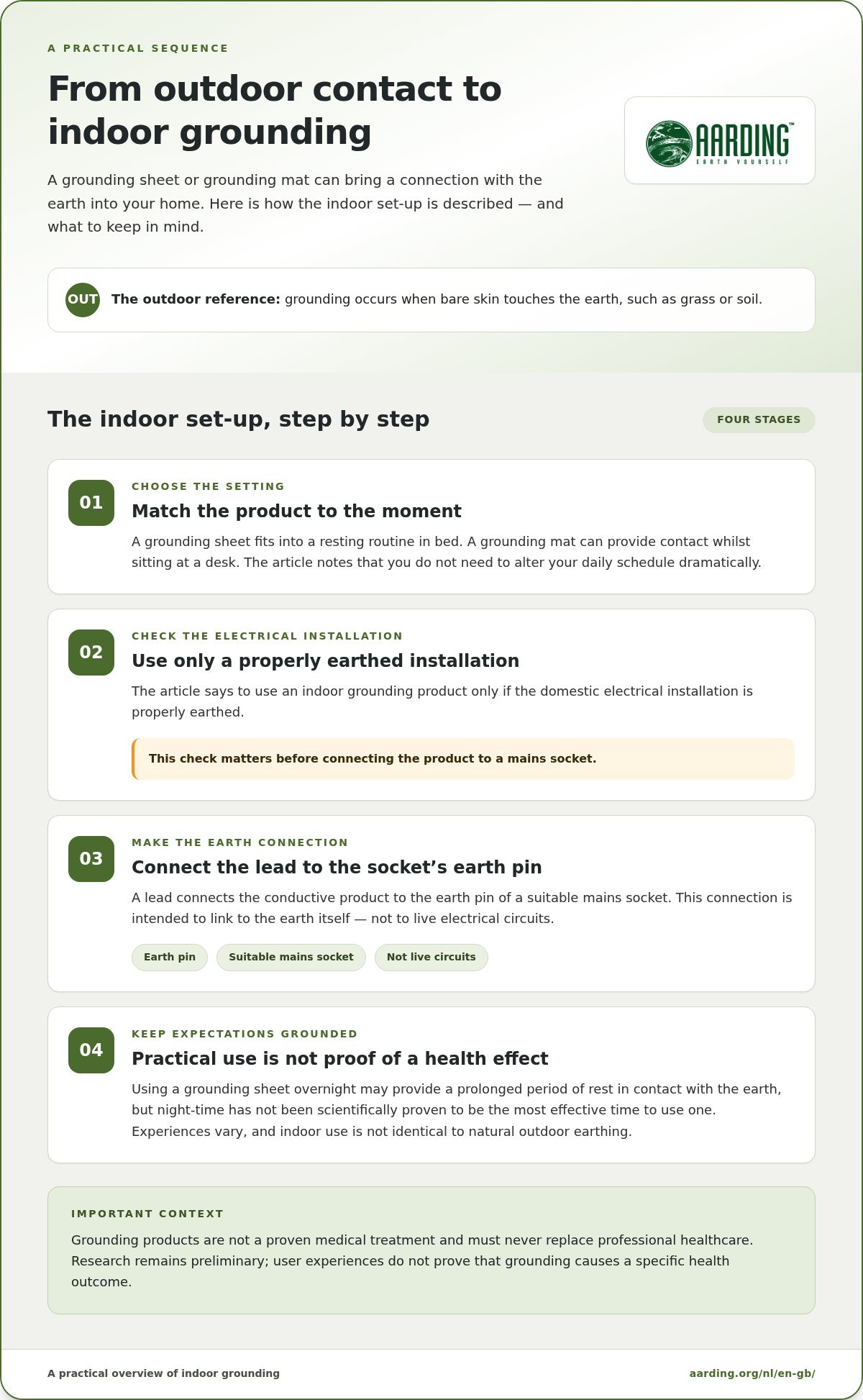
Outdoors, contact occurs naturally whenever your bare skin touches the earth. Indoors, a conductive product, such as a grounding sheet, can replicate that connection. A lead connects the product to the earth pin of a suitable mains socket. This earth connection is intended solely as a link to the earth itself, not to the live electrical circuits. Only use such a product if the domestic electrical installation is properly earthed. A grounding sheet turns sleep into a potentially prolonged period of rest in contact with the earth. Whilst practical, this does not mean night-time has been scientifically proven to be the most effective period of use.
Rubber shoe soles and synthetic flooring can sever the electrical connection between your body and the ground beneath you. That does not, however, mean your body demonstrably suffers from an electron deficiency. The term 'electron deficiency' belongs to an explanatory theory used by grounding advocates, not an officially recognised medical diagnosis.
According to this theory, contact with the earth allows free electrons to flow into the body. These electrons are thought to play a potential role in oxidative processes. This mechanism and its potential health implications remain subject to ongoing research. It is therefore vital to distinguish between a plausible theoretical explanation and clinically proven efficacy. Furthermore, natural outdoor earthing and using a product indoors are not identical experiences: the surface, skin contact, and environment all differ.
Grounding products serve primarily as a practical bridge between the outdoors and your home. A mat can provide contact whilst sitting at a desk; a grounding sheet fits naturally into your resting routine in bed. You do not need to alter your daily schedule dramatically. Do bear in mind that user experiences vary widely and are no substitute for professional medical assessment or treatment. This approach enables you to explore grounding with an open mind, without attributing every slight bodily change directly to the product.
The theory underpinning grounding revolves around electrons. The earth holds an abundant supply of free electrons that, according to proponents, can enter the body during physical contact. Because certain free radicals can absorb electrons, it is hypothesised that this transfer might influence oxidative processes. Whilst this sounds biologically plausible, it is not yet proven evidence of health improvements. Moreover, free radicals are not all positively charged, and their physiological role is far more complex than a simplistic tale of 'good' and 'bad' particles.
Researchers study parameters such as inflammatory markers, pain, sleep, and blood values. A 2025 study on mitochondria reported that earthed mitochondria produced more ATP and generated fewer reactive oxygen species. Whilst interesting, laboratory cellular research does not directly reflect what an individual will experience at home using a grounding product. Many clinical studies on grounding in humans are small and possess methodological limitations. The findings remain preliminary and do not constitute definitive proof.
In cases of chronic inflammation, persistent pain and sensitivity can hinder daily life. Under the proposed mechanism, electrons help mitigate oxidative stress, which might in turn influence inflammatory pathways. A 2024 paper by Koniver reported a rapid reduction in C-reactive protein, a standard marker of inflammation. However, this does not prove that grounding treats chronic inflammatory conditions. There is also insufficient robust evidence to claim that grounding stabilises the immune response or alters white blood cell counts following physical exertion in a predictable manner.
A possible influence on blood circulation is sometimes explained through the electrical charge of red blood cells. Research examining zeta potential suggests that grounding may alter this charge, potentially reducing blood viscosity. However, this is not an established clinical improvement in circulation and does not prove that grounding prevents or treats cardiovascular diseases. Treat such preliminary findings as interesting research questions, not as a reason to alter prescribed medical treatments.
Cortisol, a hormone central to the stress response and circadian rhythm, is also frequently linked to grounding. The body naturally follows a 24-hour cycle, but the available data are not robust enough to conclude that grounding reliably resets this rhythm. Lying quietly is inherently relaxing in itself. Research must carefully distinguish between the psychological benefit of quiet rest and any purported physical effect of electrical contact with the earth.
The autonomic nervous system helps your body switch between alertness and recovery. Several small studies on grounding report changes in heart rate variability, a measure of variation between heartbeats. This does not yet prove that regular grounding permanently shifts the nervous system into a 'rest-and-digest' mode. Individuals experiencing high stress may notice changes more quickly simply because they pay closer attention to relaxation and sleep. Expectations, routine, and personal circumstances undoubtedly shape this experience.
For this reason, experiences with grounding products call for a level-headed perspective: a personal improvement is meaningful to the individual who experiences it, but it does not make the underlying mechanism clinically proven. If you wish to explore the practical possibilities, you can find grounding products for sleep and work at Aarding.
Users report a wide variety of experiences. Some state that they sleep more soundly, wake up less frequently, or feel more refreshed in the morning when using a grounding sheet. Others notice no discernible difference at all. Such personal accounts help you understand what people hope to achieve, but they do not prove that the product caused the improvement. Sleep quality, stress levels, overall health, and expectations all interact.
Deeper sleep and fewer nocturnal awakenings are common themes in user testimonials. People troubled by restless legs also occasionally report feeling more comfortable at night, although grounding is not a medically proven therapy for such complaints. A grounding blanket can be a pleasant way for some users to maintain contact with the earthing system whilst lying down. However, this does not guarantee that you will fall asleep faster.
If you want to assess whether you notice any difference, consider tracking your sleep quality before and after introducing a product into your routine. Note down how refreshed you feel, how often you wake, and whether any other factors have changed, such as your sleep schedule or stress levels. That way, you will not base your conclusions solely on an unusually good or bad night.
Individuals with joint discomfort or rheumatic complaints sometimes report experiencing less stiffness or morning discomfort. Whilst these accounts warrant attention, they do not demonstrate that grounding was the direct cause, nor that it treats rheumatic conditions. Never modify prescribed medical treatments on the basis of personal anecdotes. Always discuss persistent or worsening symptoms with a qualified healthcare professional.
Athletes also occasionally describe feeling less sore or experiencing a quicker recovery sensation after exertion. Other users find keeping a grounding mat in their workspace beneficial during prolonged desk work, noting that they feel calmer or less prone to an afternoon dip in energy. This does not prove that a mat prevents or treats repetitive strain injuries (RSI). Regular movement, ergonomic workstation setup, and proper breaks remain essential.
Convalescence after illness can be slow and unpredictable. Some users mention feeling more relaxed or energetic whilst using grounding products. This remains a personal impression rather than scientific proof that grounding accelerates recovery. Rest, restorative sleep, and sound medical guidance must always lead the way.
Experiences during the initial nights can also vary. Some people notice nothing unusual, whilst others report temporary restlessness, tingling sensations, or changes in their sleep patterns. This is sometimes labelled as 'detoxification symptoms', but there is no scientific evidence that grounding purges toxins or that such symptoms represent a necessary adjustment phase. Do not automatically attribute new symptoms to a detox effect. Stop using the product if you feel uncomfortable, and seek medical advice for persistent or severe symptoms. This allows you to explore experiences with grounding products with healthy curiosity alongside realistic expectations.
A grounding product must offer more than mere comfort: the conductive element and the connection must work together to maintain a safe electrical link. Look for clear information regarding materials, care instructions, and connection methods. A high price tag or extravagant health claims are never proof of quality or efficacy in themselves.
In conductive fabrics, silver is often woven in as a thread or applied as a coating over another fibre. This is distinctly different from a product made entirely of solid silver. Pay close attention to how the conductive material is distributed across the surface, and ensure that washing instructions are clear. A multimeter can test electrical continuity, but it cannot measure whether a product delivers health benefits.
The base fabric also matters. organic cotton feels pleasant against the skin for many and represents a natural choice, though it may not suit every sensitive skin type. If you are prone to skin irritation, check the full material breakdown and follow the care instructions carefully. Aarding focuses on materials such as silver and organic cotton for products designed to be used during rest or work.
Product lifespan depends on frequency of use, washing habits, and general care. There is no predetermined lifespan that applies uniformly to every sheet or mat. Always launder the product according to the care label, avoid harsh agents such as bleach, and steer clear of high tumble-drying temperatures if advised against. This protects the delicate conductive fibres from unnecessary wear.
A grounding sheet or mat is typically connected to the earth pin of a mains socket, completely isolated from the live power terminals. The connection only functions as intended if your electrical installation is genuinely earthed. High-quality products incorporate an in-line current-limiting resistor as an added safety measure, but never make assumptions without checking the product documentation. Always unplug the connection during thunderstorms.
You can verify the electrical continuity of the product yourself using a multimeter, provided you know how to operate one safely. Always disconnect the product from the wall socket first. Set the meter to resistance or continuity mode, and follow the manufacturer's guidelines to test between the connection stud and the conductive surface. A positive reading confirms electrical continuity, but it does not verify whether your wall socket is properly earthed, nor does it guarantee health benefits. Never open a wall socket yourself to inspect the wiring.
Before using a grounding sheet in the bedroom, ensure your socket is properly earthed and that the connection lead is undamaged. If you have any doubts about your home's wiring, consult a qualified electrician. When selecting a product for your bedroom or office, browse the grounding products from Aarding and assess the materials and care instructions to see what best suits your lifestyle.
Aarding is founded on a straightforward principle: a subtle adjustment to your daily environment can help you reconnect with the natural world. Grounding products are not a miracle cure, and grounding is not a proven medical treatment for health conditions. However, you can explore it as a personal wellbeing ritual, approaching it with realistic expectations and paying mindful attention to how your body responds.
Experiences with grounding products vary from person to person. That is why a calm, honest approach is essential: understanding how to use the product, knowing what science does and does not support, and discovering whether it fits into your daily life. Aarding is a dedicated company offering grounding products for sleep and work, with a focus on quality materials such as silver and organic cotton.
Aarding presents grounding in a practical, transparent manner. Natural simplicity is matched by careful attention to materials and craftsmanship. This does not mean health outcomes are guaranteed. Grounding is best viewed as a complement to restorative rest and healthy lifestyle habits, without confusing commercial claims with proven medical facts.
First, consider when you would like to use the product. If you wish to connect whilst sleeping, a grounding sheet is the most logical choice. If you spend long hours at a desk, a grounding mat may fit more naturally into your daily routine. A grounding blanket can be ideal for unwinding on the sofa. Choose an option that integrates effortlessly into your existing routine.
The Aarding range includes fitted grounding sheets, half sheets, pillowcases, sleep mats, blankets, and versatile mats designed for desks or general use. Consider your personal habits: do you prefer sleeping directly on a conductive sheet, or would you rather use a mat whilst reading or working during the day? The ideal product depends entirely on your lifestyle.
Start gently and keep your expectations grounded. Follow the usage and washing instructions, ensure your connection is set up safely, and observe any changes in your comfort or daily wellbeing. You might keep a brief journal tracking your sleep quality or how you feel throughout the workday. This ensures your choices are guided by your own personal experience, without treating a single good or bad day as definitive proof.
Ready to explore options for sleep or work? Discover grounding products from Aarding. Select a product tailored to your routine and take the time to experience what grounding means for you.
You do not need to overhaul your entire lifestyle to explore a new habit. Choose a moment that already fits your day, such as going to bed or taking a short break, and notice how you feel. Do not expect immediate miracles. A calm, receptive mindset will help you distinguish between genuine observations and hopeful expectations.
Experiences with grounding products are deeply individual. What brings comfort to one person may feel unremarkable to another. View grounding as a potential complement to your wellness routine, never as a replacement for conventional medical care or established therapies. Stay curious, give yourself ample time, and pick a product that harmonises with your day-to-day life.
Curious to discover which form of earthing complements your sleep or relaxation? Explore the Aarding collection and experience it for yourself. Choose a grounding product that integrates into your routine and begin your journey at your own pace.
There is no standard timeframe for experiencing results. Some users report noticing changes within a few days, whilst others feel no difference at all. Scientific research does not provide a definitive timeline for when effects should occur. If you wish to evaluate it yourself, keep a record of your sleep quality and daytime energy levels. Avoid changing other lifestyle habits at the same time so you can assess your experiences more clearly.
There are no well-documented side effects specifically caused by grounding itself, but this does not mean every individual finds the products comfortable. For instance, you might experience mild skin irritation from textile contact or general discomfort if a sheet feels unfamiliar. Discontinue use if you experience adverse effects and see if they subside. Never dismiss persistent or concerning symptoms as a supposed 'detoxification reaction'; always consult a doctor.
No, do not connect a mat to a socket that lacks a verified earth connection. Never improvise with homemade wiring or adapted plugs to force a connection. An outdoor earthing rod driven into the soil is only suitable if the product is explicitly designed for that purpose and the manufacturer's instructions explain how to install it safely. If you are uncertain about the safety of your home's electrical sockets, have them inspected by a certified electrician.
Direct skin contact with the conductive surface is the most effective and reliable way to establish the connection. Thick or synthetic nightwear can act as an electrical insulator, making conductivity through the fabric less dependable. You do not need your entire body to touch the sheet; touching the conductive surface with one part of your body (such as your feet or legs) is sufficient according to product specifications. Always follow the guidelines for your specific item.
Grounding involves a conductive electrical connection with the earth's natural surface charge; magnetism relates to magnetic fields and magnetic forces. These are entirely distinct physical phenomena, and the terms cannot be used interchangeably. A grounding product is not a magnet and does not function by magnetising the body. Understanding this distinction helps when evaluating product claims: check whether explanations refer to electrical earthing rather than unsubstantiated magnetic effects.
Always refer to the care label and manufacturer's instructions first, as proper maintenance depends on how the fabric is constructed. Do not rely on generic laundry rules. Always disconnect the lead before laundering, and inspect the product for loose threads or damaged connection points once dry. With regular washing, pay attention to the fabric's condition to spot wear early, without pulling at the delicate conductive threads.
This depends on the fabric of your clothes and the construction of the blanket. Clothing introduces an extra layer between your skin and the conductive surface, and certain textiles can impede electrical flow. For the most reliable connection, use the blanket as advised by the manufacturer, ensuring direct skin contact where possible. Do not assume guaranteed conductivity through heavy fabrics, and follow the product's instructions.
Always seek medical guidance from your cardiologist or your pacemaker manufacturer before using any grounding product. Although grounding items are designed to connect solely to the earth pin rather than live electrical circuits, this does not constitute an individual safety assessment for your medical device. Share the product specifications and connection method with your doctor, and only use the product once you have received explicit medical approval tailored to your pacemaker.
Reacties worden goedgekeurd voordat ze verschijnen.