Je winkelwagen is nog leeg



Have you ever wondered why a yoga session in the fresh outdoors feels so fundamentally different from the same exercises on a mat indoors? The difference isn't just in the air you breathe, but in the direct, physical connection to the earth that you often miss indoors. Many practitioners struggle with a persistent feeling of restlessness in their head or a body that recovers slowly after physical exertion. You are certainly not the only one seeking the natural synergy between body and ground in a modern, isolated environment.
In this article, you will discover how grounding during yoga merges the mental calm of your practice with the biological benefits of physical grounding for optimal balance and vitality. We discuss how you can easily bring the natural energy of the earth into your living room using a grounding mat made from high-quality organic cotton. You will learn how this process of electron exchange can reduce inflammation and help you build a more effective routine that goes beyond just flexibility. We will delve into the science of nervous system regulation and show how this simple addition accelerates your path to inner stillness and physical well-being.
Within the yoga tradition, the concept of 'grounding' or 'earthing' is deeply rooted. You often hear instructors say that you should press your feet firmly into the mat or sink your sit bones to find stability. Whilst these are excellent instructions for your mental focus, the true meaning of grounding during yoga goes far beyond just a conscious thought. It is a physical reality that is often overlooked in our modern world. We spend most of our time indoors, on insulating rubber soles or on synthetic mats, losing direct, biological connection with the earth.
This loss of contact has tangible consequences for your well-being. When you are not grounded, energy often remains high in your body, which can manifest as a full head, persistent worrying thoughts, or a general feeling of being rushed. By physically grounding, you utilise principles also described in nature therapy (ecotherapy), where interaction with the natural environment is central to human recovery. It helps you to literally drop out of your head and back into your body, allowing your practice to reach a deeper layer of calm and presence.
In the energetic anatomy of yoga, the root chakra, also known as Muladhara, is central to finding stability. This energy centre is located at the base of the spine and forms your fundamental foundation. When this chakra is balanced, you feel safe, calm, and fully present in the moment. A lack of grounding, however, can manifest as feelings of anxiety and insecurity. It is as if you are a tree without deep roots; you wobble at the slightest gust of wind. By consciously working on the connection with the ground, you symbolise the shooting of roots into the earth. This has a direct, calming effect on your nervous system and strengthens your sense of inner power.
Yoga is at its core intended as a means to find balance between body and mind. Without a solid physical foundation, every asana, or yoga pose, is merely an exercise in space. A physical connection with the earth significantly enhances the energetic benefits of your practice. It ensures that the calm you find on the mat does not immediately dissipate once you leave the studio. By using aids such as a grounding mat made from organic cotton, you restore the biological link often missing indoors. Thus, grounding during yoga becomes not only an intention but an essential part of your natural recovery process that helps you to remain centred throughout the day.
To understand how grounding during yoga affects your body, we must look at human biology as an electrical system. Your body is an excellent conductor, partly due to its high water and mineral content. The earth has a subtle negative electrical charge and is an inexhaustible source of free electrons. When you make direct contact with the ground, a closed circuit is created. This is not a spiritual metaphor, but a process of electron exchange that stabilises your biological systems. In our modern environment, we often build up a positive charge due to insulating materials and electromagnetic fields, which can lead to chronic tension.
Physical grounding acts as a natural antioxidant. Free radicals, positively charged molecules that are essential for your immune system but cause damage to healthy cells in excess, are constantly formed in your body. The negatively charged electrons from the earth neutralise these free radicals directly upon contact. This process helps to regulate cortisol levels, your main stress hormone, bringing them back to a healthy rhythm. This electrical discharge signals to your body that it is safe, paving the way for profound recovery.
The most directly noticeable change during grounding is the shift in your autonomic nervous system. It helps your body transition from the sympathetic nervous system (fight or flight) to the parasympathetic nervous system (rest and digest). Recent insights from a systematic review in 2025 show that this form of natural connection can modulate genes involved in immune regulation and inflammatory responses. When you combine grounding during yoga with conscious, deep breathing, you strengthen this synergy. The electrical discharge accelerates the calming of your nervous system, allowing you to reach a state of deep meditation and physical relaxation more quickly.
After a powerful Vinyasa or an intensive Hatha session, your body needs time to process waste products. Grounding improves microcirculation in your blood vessels, which is essential for the removal of lactic acid from your muscles. This not only promotes flexibility but also reduces the chance of muscle soreness the next day. If you practise in the evening, the electrical connection also helps to synchronise your biological clock, significantly improving sleep quality. For those who practise indoors, a grounding mat is an effective way to experience these biological benefits without having to go outside. It offers you the opportunity to passively work on your health whilst performing your familiar asanas.
Grounding during yoga begins with the conscious, physical connection you make with your ground. It is an active dialogue between your body and the earth. Before you begin the first pose, it helps to set a Sankalpa, or intention. Formulate a short sentence for yourself such as: "I am firmly connected and balanced." This mental focus strengthens the physical actions that follow. Standing poses are essential here; they form the bridge between your internal energy and the stability of the world beneath your feet.
Mountain Pose is the blueprint for all standing asanas and the purest form of grounding. To optimise the connection, focus your attention on the four corners of your feet: the ball of the big toe, the ball of the little toe, the inside of the heel, and the outside of the heel. Press these points evenly into the mat. Feel your arches lift slightly, drawing energy up from the earth through your legs. Visualise powerful roots growing deep into the ground from the soles of your feet. This visualisation helps you to create an unshakeable foundation, no matter what is happening around you.
In Tree Pose, you find balance by literally anchoring yourself in your standing leg. The stronger the downward pressure from your foot, the more length and lightness you experience in your upper body. It is the art of rooting to be able to grow. Use your Drishti, a fixed focal point for your eyes, to maintain your concentration and calm your nervous system. Beginners can gently rest the toe of the lifted foot on the ground. This ensures that the focus remains on safe grounding, rather than on maintaining a shaky balance.
The final resting pose, Shavasana, is the moment when you release all effort and completely surrender to gravity. You allow every muscle group to soften and, as it were, merge with the mat. This is the moment when the biological exchange of electrons, which we discussed earlier, is most effective because your body's contact with the ground is maximised. To deepen this experience, you can use an Earthing Blanket. This special grounding blanket not only offers security through its weight but also restores the electrical connection with the earth. It helps you to enter a state of deep, restorative rest that continues for hours after your practice.
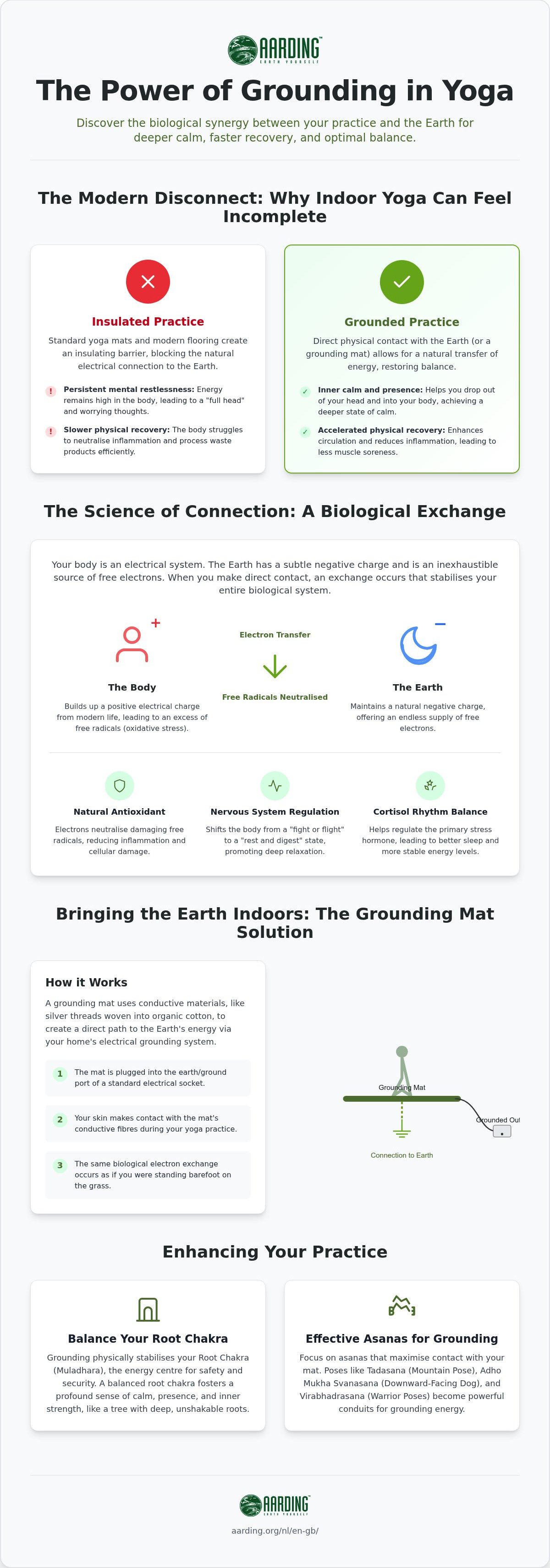
Most yogis pay a lot of attention to their posture and breathing, but rarely consider the mat beneath their feet. Traditional yoga mats made of rubber, TPE, or PVC are excellent insulators. This means they completely block the flow of electrons, which we discussed earlier. You perform your exercises, but you remain biologically isolated from the restorative power of the earth. In a modern studio or at home on a wooden floor, you are physically separated from the source that can calm your nervous system.
A grounding mat changes this. Whether you practise in a ground-floor studio or in a tenth-floor apartment, this mat restores the connection. By using your home's earthing wire, the mat acts as an extension of the natural ground. This makes grounding during yoga an effortless part of your indoor practice. It is a simple way to bridge the gap between your urban lifestyle and your biological needs.
The switch from a standard synthetic mat to a mat made of organic cotton with silver fibres is a conscious choice for your health. Synthetic materials such as PVC are not only harmful to the environment but also hinder your body's natural electrical discharge. A high-quality grounding mat combines the comfort of natural fibres with the necessary conductivity. It is a sustainable investment in your well-being. These materials ensure that every minute on the mat actually contributes to your physical recovery and the neutralisation of free radicals.
Using a grounding mat is surprisingly simple and fits into any routine. You connect the mat to an earthed socket with the included cable. It is essential to have direct skin contact between you and the mat; bare feet or hands ensure the best conductivity. You can use the mat directly on the floor or, for extra cushioning, place it over your existing yoga mat. The latter is ideal for more dynamic forms of yoga where you desire extra grip and softness.
Maintaining your organic cotton grounding products is important to preserve the conductivity of the silver fibres. Regular washing removes skin oils and sweat that can reduce conductivity over time. Use a mild detergent without bleach or fabric softener to optimise the quality of the fibres. Do you want to experience the benefits of this technology yourself and deepen your practice? Then explore the collection and choose the right grounding mat for your personal needs.
The calm and balance you experience through grounding during yoga does not have to stop as soon as you step off the mat. It is a foundation that you can support throughout the day. Many people experience renewed clarity after their session but lose it again in the hustle and bustle of emails and traffic. By incorporating small, conscious rituals, you maintain that connection with the earth and prevent stress from accumulating in your system again. After all, a healthy lifestyle begins with the foundation beneath your feet and the way you allow your biological system to discharge.
Consistency is key to long-term results here. Just as your yoga practice strengthens through regular repetition, so does your physical grounding. It is about constantly giving your body the opportunity to drain excess positive charge. This aligns with the growing trend of nervous system regulation, where we learn to actively help our body manage its stress response. By integrating grounding into your daily routine, you create a constant flow of recovery.
Nothing beats the direct power of nature. A simple barefoot walk through the grass or across the sand of a beach immediately restores your biological balance. Contact with the natural ground helps to calm your senses and brings your focus back to the here and now. If weather conditions permit, practising yoga in the fresh air is the purest way to experience the benefits of grounding. The natural environment enhances the effects of your breathing and helps you to get out of your head more quickly.
Because we spend most of our time indoors, it is essential to optimise your living environment for recovery. Sleep is the most important time for your body to repair and discharge itself. By using a grounding sheet made from organic cotton, you facilitate this process throughout the night without extra effort. It is a form of passive healthcare that seamlessly fits a conscious lifestyle. Your body can completely rid itself of the day's accumulated tension during deep sleep phases.
Additionally, you can use a grounding mat in places where you spend a lot of time, such as under your desk whilst you work or by the sofa during a moment of relaxation. This helps to keep your nervous system in a parasympathetic state throughout the day, which benefits your focus and energy levels. Are you ready to take the next step in your well-being and extend the benefits of grounding during yoga throughout your entire day? Discover how you can deepen your practice with a grounding mat from Aarding and experience the difference of a grounded life for yourself.
Grounding during yoga is much more than a symbolic act; it is a biological necessity that helps you return to your natural state of balance. By stimulating the direct transfer of free electrons, you give your body the chance to regulate stress hormones and effectively tackle physical inflammation. This scientifically proven method ensures that the calm of your practice does not just stay in your head but penetrates deeply into every cell of your body for faster and more powerful recovery.
As a specialist in grounding technology since 2012, Aarding offers high-quality solutions that effortlessly fit into a modern and healthy life. Our products are carefully crafted from sustainable organic cotton and have supported thousands of satisfied customers in the Netherlands and Belgium on their path to vitality. Grant yourself the unshakeable stability and biological balance that come from a direct, physical connection with the earth.
View our collection of grounding mats for a deeper yoga experience
Start anchoring your well-being today and feel the soothing power of the earth beneath your feet.
It is the physical connection between your body and the earth during your practice. This involves an exchange of electrons that stabilises your biological systems. By grounding during yoga, you combine mental focus with a process that neutralises free radicals and calms your nervous system. It transforms a standard session into a profound recovery moment where you use the natural energy of the ground to restore your inner balance.
No, most standard mats made of rubber or PVC act as insulators. They completely block the flow of electrons from the earth to your skin. To truly ground physically indoors, you need a conductive surface. A grounding mat made from organic cotton and silver fibres is specifically designed to restore this connection. Without such an aid, you will experience the mental calm of the poses, but you will miss the biological benefits.
The first effects on your nervous system are often noticeable within seconds. Your cortisol levels begin to stabilise, and your muscles relax more deeply. For structural benefits, such as reducing inflammation and improving your recovery, a session of 30 to 45 minutes is ideal. The longer the contact lasts, the more time your body has to neutralise positive charges and achieve a state of natural biological balance.
Yes, its use is completely safe because the mat only connects to the earthing wire of your electrical system. No electricity flows through the mat; it merely facilitates the natural transfer of electrons from the ground. Since 2012, we have specialised in this technology to guarantee a reliable experience. It is a safe way to bring the energy from outside indoors without any associated technical risks.
Scientific research shows that grounding has a significant impact on our physiology. By neutralising free radicals, it helps to lower inflammatory markers in the blood. This process also shifts your autonomic nervous system from a stress state to a rest state. This makes grounding during yoga an effective tool for anyone who wants to reduce chronic tension and accelerate physical recovery after intensive exertion or a busy day.
Direct skin contact is essential for good electron conductivity. Bare feet are the most effective contact point, especially in standing poses where the pressure on the mat is maximised. However, any part of your skin that touches the grounding mat will facilitate the transfer. If you find it too cold, you can wear special conductive socks, but for the purest experience, we recommend placing your hands or feet directly on the surface.
Absolutely, a grounding blanket is extremely suitable for seated practices or during final relaxation in Shavasana. The weight of the blanket offers a sense of security, whilst the conductive fibres ensure you remain connected to the earth's energy. It helps to deepen your focus and prevents your thoughts from wandering. It is an excellent way to maintain your grounded state, even when you are not actively moving on your mat.
Tadasana, also known as Mountain Pose, is the most effective exercise for quickly establishing a strong connection. By consciously standing on your grounding mat and distributing your weight over the four corners of your feet, you directly activate the grounding process. Focus on the downward pressure and visualise roots growing into the ground. This simple pose immediately calms your nervous system and brings your attention back to your physical core and the stable ground.
Reacties worden goedgekeurd voordat ze verschijnen.