Je winkelwagen is nog leeg



A compelling story about better sleep can offer hope, but it does not prove that a grounding sheet will do the same for everyone. Anyone searching for grounding sheet experiences will encounter personal stories that sometimes contradict one another. That is entirely understandable: sleep and well-being can be influenced by all manner of factors.
You might wonder what users actually notice and how to distinguish a genuine experience from a firm health claim. There is no need to dismiss personal accounts out of hand, but do read them attentively. Look, for instance, at how long someone has used the sheet, how it is connected, and whether the author describes concretely what changed. A personal story can offer valuable insight into someone's experience, but in itself, it is not proof of efficacy.
In this article, you will discover how to evaluate experiences critically and what questions to ask yourself regarding materials, use, and product choice. This will allow you to consider calmly whether a grounding sheet suits your circumstances, without mistaking an expectation for a certainty.
An experience recounts what someone noticed personally, not automatically what the grounding sheet caused. Keeping that distinction in mind helps you read stories with an open yet discerning mind. A personal story can be valuable, but on its own, it does not prove that the product produces a specific effect.
On the brand page of Aarding, you will find testimonials featuring positive feedback about sleep, relaxation, and rest. These are user experiences published within a commercial context. Consequently, they are not the same as independent reviews. The available information provides no basis for determining how frequently such experiences occur or whether they represent all users.
A user experience describes what someone observed during or after using a product. Such a description does not demonstrate whether the product caused the change, nor does it inherently say anything about other people. Similarly, satisfaction with practical matters—such as the fit or the feel of the fabric—is entirely different from a measurable change in health.
Suppose someone shares that they sleep more soundly after introducing a grounding sheet. That experience may be entirely genuine. Nevertheless, from sequence alone, one cannot deduce that the sheet was the cause. Expectations can colour how someone perceives and describes changes. An adjusted bedtime routine, reduced stress, or another change during the same period could also play a part.
It is therefore helpful to distinguish between three types of information:
A testimonial can be a good starting point for asking questions, but it cannot replace rigorous research into health outcomes. For a neutral overview of the concept of grounding (Earthing), you can read how the idea is described and what scientific critique exists. When comparing experiences, look at who published them, what circumstances are mentioned, and whether the author shares concrete observations. In this way, you can gather useful insights from personal stories without turning a single experience into a general conclusion.
According to general product descriptions, grounding sheets contain conductive materials that facilitate contact with the earth. This describes the intended mechanism of the product. However, it does not prove that using it causes health benefits. Keep these two questions separate: how a product is intended to work according to the manufacturer, and what scientific research actually shows.
Conductivity is a material property: it allows the material to conduct electrical charge. Which conductive fibre or other materials are woven into a specific sheet, and precisely how it is connected, can vary from product to product. Always check the current product information before relying on material names or technical instructions. For example, if a product is described as being made from organic cotton, that composition should be stated explicitly in the product specifications.
General explanations describe what the conductive property is intended to do, but they do not state the exact composition of every grounding sheet or how each specific model should be used. For connection and maintenance, always follow the manufacturer's instructions supplied with the specific item. Avoid applying details from another brand or model without checking.
User stories describe personal observations. They can help you understand how someone perceives using the product, but on their own, they do not demonstrate what caused any perceived change. When evaluating scientific research, consider factors such as the study design, the number and characteristics of participants, the chosen endpoints, and the limitations noted by the researchers.
The available body of research surrounding grounding is generally described as preliminary. This does not mean that every personal experience is invalid, but it does mean that definitive conclusions should be approached with caution. A reported change in sleep quality or relaxation is not identical to an objectively measured outcome. Furthermore, a measured difference does not automatically prove that the grounding sheet was the sole cause. Robust conclusions require appropriate, rigorously conducted studies.
Use product descriptions to understand what the sheet is designed to do, and evaluate health claims independently. If you wish to compare product features, take a look at these grounding products for home and office and verify the specifications of the model that suits your intended use. This ensures your choice is based on verifiable information rather than merely on expectations or anecdotes.
A grounding sheet, half sheet, grounding blanket, and grounding mat differ primarily in form and setting of use. In international literature and discussions, a grounding sheet is commonly referred to by that exact term. When comparing user accounts, first check what someone actually used and when. A story about sleeping on a full sheet does not automatically apply to a mat used during the working day. Product format is not a hierarchy of effectiveness.
| Product Type | Intended Moment of Use | Practical Considerations |
|---|---|---|
| Grounding sheet | Whilst sleeping | Check whether the dimensions fit your mattress and how the supplier instructs it to be used. |
| Half sheet | During rest or sleep | Review the placement instructions and consider whether this fits comfortably into your routine. |
| Grounding blanket | A moment of relaxation, depending on product guidance | Pay attention to the stated application and how you prefer to use the blanket comfortably. |
| Grounding mat | Use outside bed, depending on the specific model | A desk mat may suit a workspace; check the specifications of the mat you are considering. |
A grounding sheet is designed for use whilst sleeping. Whether this format suits you depends, amongst other things, on your bed type, sleeping routine, and personal preferences. Before comparing experiences, verify confirmed product details, such as the stated dimensions and usage instructions. Avoid assuming features that are not explicitly stated for that specific product.
A mat can be suitable for use at home or in an office, but the precise moment of use depends on the type of mat and the manufacturer's advice. A desk mat and a sleeping mat, for instance, are distinct product types. When researching, the terms grounding mat and grounding blanket will help you find specific user experiences for mats and blankets respectively.
Pay close attention to what the user describes: are they discussing convenience, where the item was placed, or a perceived change in well-being? These represent very different types of feedback. Even when two people report similar changes, their experiences cannot be directly compared if the product format, timing of use, routine, and expectations diverge. A grounding blanket, grounding mat, and grounding sheet are different formats, not proven tiers of effectiveness.
Use experiences primarily to identify practical considerations. Does the product fit into your daily routine? Are the specifications clear? Is the experience shared by an everyday user or a retailer? By keeping this context in mind, you can weigh grounding sheet experiences and reviews of other product formats more carefully, without taking them as proof of an inevitable outcome.
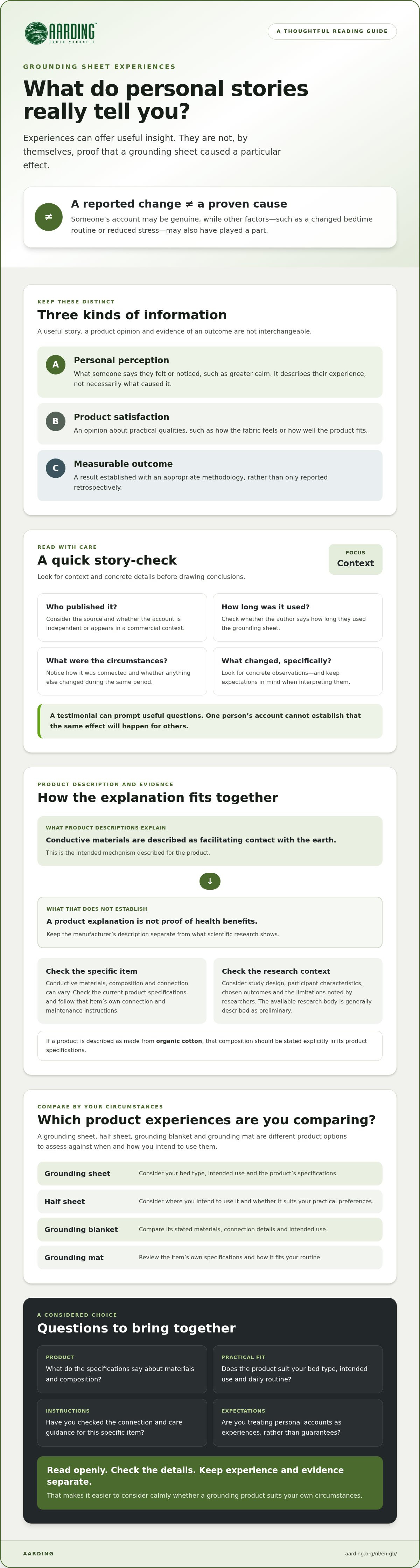
A review is far more useful when you understand not just what someone concluded, but how they arrived at that conclusion. Use this checklist to weigh grounding sheet experiences critically. Reviews can offer helpful perspectives, but they do not constitute clinical evidence.
Where possible, look for multiple reviews that match the product format and usage scenario you are considering. This makes the accounts easier to compare, though it still does not turn them into clinical proof. Be especially cautious of reviews that promise cures, make sweeping medical claims, or use definitive language without substantiating how the conclusion was reached. A persuasive tone is no substitute for solid evidence.
If you decide to try a grounding sheet, you might find it helpful to make a brief note beforehand of your expectations and what you wish to observe. Keep your notes straightforward. For example, jot down how well you feel you slept, whether your routine shifted, and whether other factors came into play, such as an earlier bedtime or changes in caffeine intake. This prevents a single atypical night from distorting your overall impression.
Where possible, avoid changing multiple habits at once if you wish to observe whether a difference might be linked to the sheet. While tracking your own routine does not turn your notes into a controlled scientific study, it will help you separate genuine observations from recall bias. Be sure to note down if you perceive no difference at all. A subjective observation does not constitute a medical finding, nor does it guarantee what someone else will experience.
If you would like to compare technical details alongside reviews, explore these grounding products and their specifications. Use those details to compare practical features rather than treating a health outcome as a certainty.
A grounding sheet might be suitable if you are curious about this category of wellness items and using one during sleep fits naturally into your daily routine. This is a practical lifestyle choice, not a guarantee of specific results. Other people's experiences can help you formulate sensible questions, but your decision does not need to rely on an assumed health outcome.
Start by considering your bed and sleeping habits. Do you sleep in a single or double bed? Do you want something to use whilst sleeping, or would an alternative format better suit your daily schedule? The right choice depends on the verified product details, the dimensions of your mattress, and what feels practical and manageable for you.
Check the current product specification page for the specific model you are considering. This prevents you from assuming that qualities found in one product apply to another. Be sure to check:
If information is missing or unclear, ask the supplier for clarification rather than making assumptions. Choose a product type based on your lifestyle and preferences, not on a promise of health results.
Aarding provides grounding sheets for single and double beds, alongside half sheets, grounding blankets, pillowcases, and mats. These diverse formats are designed for different practical situations. Compare them on their verified product specifications and practical merits, rather than an assumed ranking of effectiveness. Aarding offers wellness products; it does not provide medical consultations or professional electrical installation. Consequently, grounding products should never be used as a replacement for appropriate medical care.
Take your time to weigh up the options. You can explore the Aarding range and decide for yourself which format, size, and instructions best suit your needs. In this way, grounding sheet experiences serve as helpful anecdotal context, whilst your purchase decision remains calm, informed, and realistic.
Grounding sheet experiences can show how individuals perceive using these products, but they do not constitute standalone proof of health benefits. Read them with careful attention to the source, the circumstances, and individual expectations. Consider also the differences between a grounding sheet, half sheet, grounding blanket, or grounding mat: the right choice depends on your bed, your routine, and your preferences, not on an unverified outcome.
Before purchasing, check the current product specifications and care instructions. Aarding offers various grounding products designed for relaxation and daytime use, but does not provide medical consultations or electrical installation services. You should never view a product as a medical treatment or as a substitute for professional healthcare.
Would you like to compare the options at your own pace? Find out which grounding product suits your needs and take the time to evaluate the information carefully. A well-considered decision begins with realistic expectations and what fits seamlessly into your daily life.
Grounding sheet experiences are personal accounts shared by people who use a grounding sheet. They describe, for instance, how an individual perceives the product within their regular bedtime routine. Such accounts offer an interesting glimpse into subjective experiences, but they do not prove that the sheet produces a specific physiological effect. When reading reviews online, notice who shared them, the circumstances under which the product was used, and whether any commercial affiliation exists.
User experiences frequently describe positive changes, but they cannot guarantee that you will experience the same. Expectations, sleep hygiene, and other lifestyle modifications occurring during the same timeframe can all have an effect. It is best to read personal stories as subjective perceptions rather than evidence of cause and effect. If you wish to assess health claims, consult independent research and take note of study design and potential limitations. Avoid viewing benefits as established facts when the evidence base remains preliminary.
Look at who wrote the review, whether any affiliate or commercial relationship is declared, and how much concrete context the author provides. A description detailing the setting of use, initial expectations, and precise observations is far more informative than a generic verdict. Even so, detailed reviews remain subjective. Be cautious of reviews promising medical cures or guaranteed improvements. Reviews can help you formulate practical questions, but they do not replace independent clinical research or professional medical advice.
A grounding sheet is designed specifically for use on a bed, whereas a grounding mat is an alternative format intended for different settings, such as at a desk or underfoot whilst relaxing. The exact application, dimensions, and specifications vary by product. Always check the supplier's technical details before comparing items. The difference in format does not imply a difference in therapeutic effectiveness. Focus on which product fits your bed, routine, and living space, and compare reviews of the same product type and usage scenario.
Experiences regarding sleep vary greatly between individuals and do not in themselves demonstrate that a grounding sheet caused a particular change. Sleep quality is influenced by numerous factors, including daily habits, stress, bedroom environment, and general health. View testimonials as personal perspectives rather than guarantees or medical proof. When reading reviews, bear in mind other lifestyle changes that may have occurred simultaneously. If you experience persistent sleep difficulties, speak to a qualified healthcare professional.
Always follow the manufacturer's specific instructions supplied with the product and refer to the seller's current technical guidance. Connection methods and care guidelines can vary between models, so avoid making assumptions if information is missing. If any instructions seem unclear, contact the supplier for clarification before connecting the product. Aarding does not carry out electrical installations; general product information is never a substitute for model-specific instructions.
Information provided by Aarding classifies grounding sheets as wellness products, and the company does not offer medical consultations. This does not confer medical device status, nor does it imply therapeutic efficacy or medical indications. Consult official product specifications and independent regulatory sources to check a product's formal classification. Never use a grounding sheet as a substitute for professional medical diagnosis or treatment. Always discuss persistent health concerns or alterations to your care plan with a qualified medical practitioner.
Reacties worden goedgekeurd voordat ze verschijnen.