Je winkelwagen is nog leeg



Can a more restful night depend on more than just your bedtime routine — for instance, direct contact with the earth? Anyone searching for grounding sheet experiences will discover a wide variety of stories. Some users notice a marked difference in their sleep or relaxation levels, whilst others feel nothing at all. This scepticism is completely understandable, particularly if you have already tried numerous sleep aids and are faced with contradictory information online.
A grounding sheet makes indoor grounding possible, but that does not automatically mean you will sleep better or experience less discomfort. The suggested explanation — that contact with the earth can influence inflammatory processes — remains a hypothesis rather than a proven physiological mechanism. Furthermore, the placebo effect cannot be ruled out in the small-scale studies currently available. It is therefore wise to maintain realistic expectations.
In this article, you will discover what user experiences can and cannot tell us, what scientific research has shown so far, and what to keep in mind for safe use. We also compare a grounding mat and a grounding blanket with a fitted sheet, helping you determine which form of grounding best suits your personal sleep routine.
In a modern home, we rarely have direct physical contact with the ground: footwear, synthetic flooring, and multi-storey buildings act as insulating barriers. Earthing, also referred to as grounding, describes direct contact with the earth or the use of a conductive product connected to an earthed point. Outdoors, you can establish contact simply by walking barefoot. Indoors, a grounding sheet provides a way to incorporate this principle into your sleeping environment.
The numerous personal anecdotes shared online show that people are genuinely intrigued by grounding, but they do not prove that everyone will experience the same outcome. The concept resonates with a growing interest in simple habits centred on rest and overall wellbeing. A fitted sheet allows contact with a conductive surface without requiring you to alter your sleep routine drastically. Aarding has specialised in grounding technology since 2012, crafting products made from organic cotton interwoven with pure silver thread.
One proposed mechanism for grounding is that free electrons from the earth can migrate into the body via a conductive surface. These electrons are hypothesised to neutralise free radicals and thereby potentially influence inflammatory processes. Whilst this sounds biologically plausible, the mechanism is still a working hypothesis rather than an established medical fact. Earthing therapy provides an objective overview of the concepts surrounding grounding alongside the prevailing scientific scepticism.
Sleep offers a practical window to apply this principle: you remain in one place on the same surface for hours without needing to dedicate active time to it. However, that does not automatically make the night the most effective time to ground. Clinical research has yet to prove definitively that a grounding sheet enhances recovery purely because the body absorbs electrons during sleep.
For many, grounding fits naturally alongside established healthy habits such as maintaining a consistent sleep schedule, winding down before bed, and spending time outdoors. The convenience is undeniably appealing: once the fitted sheet is properly connected, it integrates seamlessly into your nightly routine. It is best viewed as a complementary lifestyle practice rather than a substitute for sound sleep hygiene or qualified medical care.
Grounding sheet experiences differ from person to person. Personal expectations, your bedroom environment, daily stress levels, and individual sensitivity can all influence how you perceive your nights. The placebo effect can also play a substantial role: simply expecting to sleep more soundly can shape your subjective experience. It is entirely valid to remain curious about what you might notice yourself, without taking personal testimonials as conclusive proof of a biological effect.
Personal accounts of using a grounding sheet are sometimes presented as a predictable progression: subtle tingling at first, followed by deeper sleep, and noticeably higher energy levels within a month. In reality, there is no validated timeline that applies universally. One person may notice nothing out of the ordinary, whilst another reports distinct shifts in relaxation or sleep quality. Such observations are valuable as individual anecdotes, but on their own, they do not prove that grounding was the direct cause.
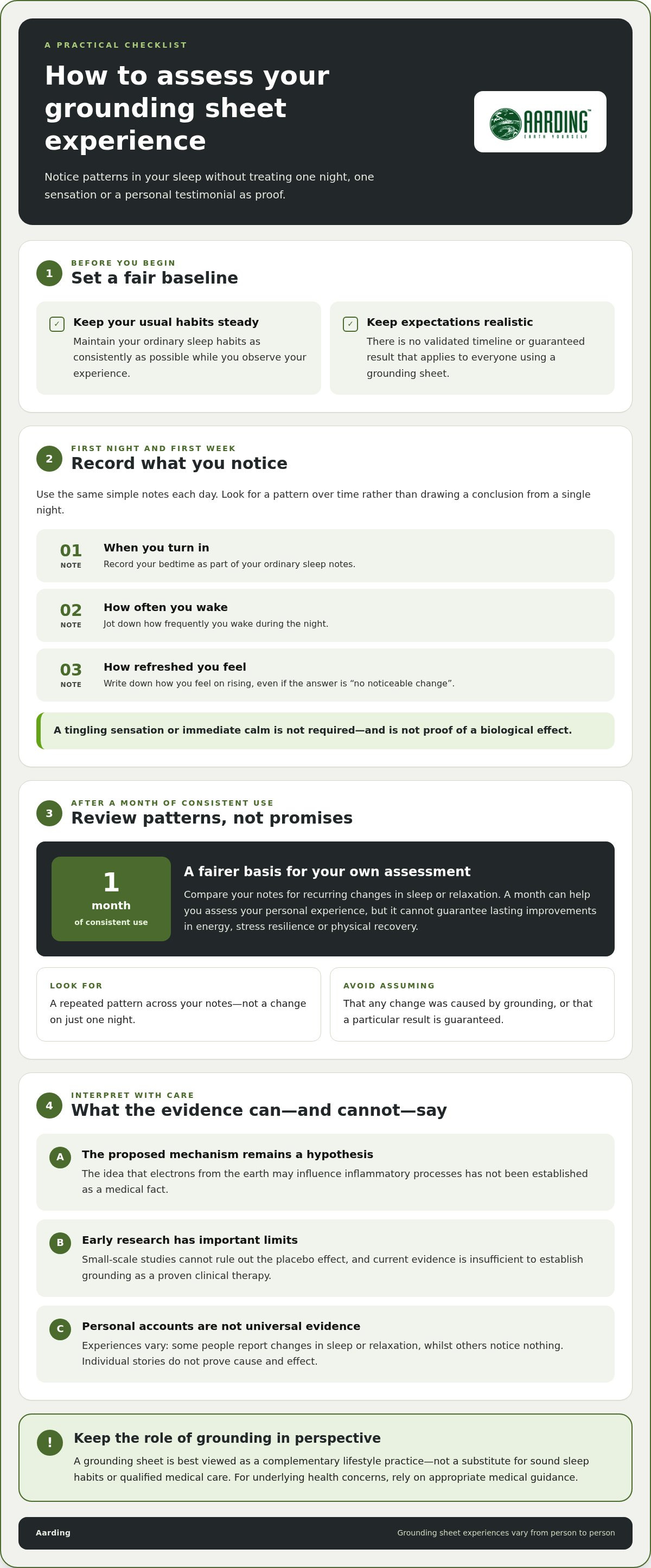
A mild tingling sensation or an immediate sense of calm frequently appears in testimonials, but it is neither a mandatory response nor definitive proof that the sheet is exerting a biological effect. Similarly, claims that a grounding sheet immediately soothes the sympathetic nervous system or reduces heart rate lack sufficiently robust evidence to be promised as an expected outcome. Feeling calmer can stem from various factors, including the psychological comfort of anticipating a restorative night's rest.
During your first week, keep your ordinary sleep habits as consistent as possible. Note down when you turn in, how frequently you wake during the night, and how refreshed you feel upon rising. This allows you to observe whether a genuine pattern develops, without treating any single night as conclusive evidence for or against grounding. There is no reliable scientific basis for asserting that your circadian rhythm will fully synchronise with grounding within seven days.
A month of consistent use provides a much fairer basis for evaluating your own experience, though it cannot guarantee a permanent boost to your energy, stress resilience, or physical recovery after exercise. A scientific review on grounding discusses the proposed mechanisms and preliminary observations. However, current evidence remains insufficient to classify grounding as a proven clinical therapy for stress, chronic conditions, or athletic recovery. Always rely on appropriate medical guidance for underlying health concerns.
Some proponents refer to temporary fatigue, restlessness, or vivid dreams as a 'detox reaction'. There is no persuasive scientific evidence demonstrating that such symptoms indicate the body is purging toxins as a result of grounding. Consequently, you should never automatically attribute new or persistent physical complaints to a presumed healing process.
A consistent routine makes it far easier to evaluate your personal experience fairly. That does not mean daily use yields guaranteed physiological benefits. Avoid altering several lifestyle habits simultaneously if you want to understand what the sheet is doing for you. Keep a simple log of your sleep quality, daytime energy, and any physical sensations, whilst remaining objective about the results. This places your grounding sheet experiences into clear context, preventing an isolated good or bad night from dictating your overall verdict.
Interested in exploring indoor grounding during sleep? Take a look at the range of grounding products from Aarding as a potential addition to your evening routine.
Testimonials about deeper slumber can certainly pique your curiosity, but personal stories do not equate to clinical proof. Scientific literature on grounding consists primarily of small pilot studies and preliminary findings. It is essential to distinguish between what researchers have observed in controlled settings and what has not yet been convincingly proven. The medical perspective from the Cleveland Clinic similarly underscores that health claims must be evaluated with healthy scrutiny.
A small study from 2004 involving twelve participants observed shifts in nocturnal cortisol profiles during grounded sleep. Whilst this is an intriguing observation, a study of this size cannot establish that a grounding sheet consistently optimises morning cortisol peaks or stabilises the endocrine system for the wider population. Nor is there conclusive proof that grounding halts racing thoughts or accelerates sleep onset. Psychological relaxation, positive expectations, and adjustments to your evening routine can all influence how quickly you drift off.
Another pilot study from 2013 involving ten participants reported changes in the surface electrical charge of red blood cells and reduced blood viscosity following grounding. Such a small sample size does not prove that a fitted sheet improves cardiovascular circulation or prevents vascular disease. These findings should be viewed as preliminary scientific inquiries rather than medical guarantees. Substantiating claims regarding prevention or therapeutic treatment requires rigorous, independently replicated clinical trials.
A grounding sheet consists of soft fabric woven with a conductive medium. The fitted sheets from Aarding are made using organic cotton interwoven with fine silver thread. The cotton provides a comfortable, breathable textile surface to sleep on, whilst the silver thread establishes a conductive pathway when the sheet is correctly connected to an earthed wall socket. Conductivity simply describes the physical capacity of a material to allow the passage of electrical charges; it does not in itself prove that a product confers health benefits.
Always follow the manufacturer's care guidelines. Laundering and handling the sheet carefully preserves the integrity of the delicate conductive fibres over time. Wear, harsh detergents, or mechanical damage can degrade the silver threads and impair conductivity.
It is also prudent to remain cautious regarding claims that a grounding sheet shields against electromagnetic fields (EMFs) in the bedroom. A grounded conductive connection does not automatically equate to proven EMF protection, nor has the clinical relevance of such claims been established in everyday domestic settings. When assessing grounding sheet experiences, evaluate three separate aspects: the tactile comfort of the fabric, whether the physical connection is functioning, and whether any broader health claims are supported by independent research. This helps keep textile quality distinct from scientific proof.
A review merely describes what one individual felt, not what every user is guaranteed to experience. Someone who sleeps noticeably better after purchasing a grounding sheet may well be delighted, yet that individual outcome does not prove that grounding was the underlying cause. Expectancy effects, an improved bedtime routine, and the placebo response can all play a part. When reading testimonials, pay close attention to context: does the reviewer specify how long they used the product, how it was connected, and precisely what changes occurred?
Examine the technical specifications of the product as well. The base fabric, craftsmanship, percentage of conductive thread, and the clarity of care instructions provide objective benchmarks for comparing options. A glowing five-star rating does not inherently confirm the reliability of the electrical connection or the validity of associated wellness claims.
A fitted sheet can only function as intended if it is linked to a genuinely earthed domestic socket. Check your socket using a certified socket tester and follow the instructions provided with that device. Never insert loose multimeter probes directly into an electrical mains socket. If you have any doubts about your home's electrical wiring, refrain from using the sheet until the earthing has been professionally confirmed as safe.
You can check the electrical continuity of the conductive fabric using a digital multimeter. Follow the exact instructions provided by the sheet manufacturer and the meter manual. Measuring the fabric will demonstrate whether continuity exists across the surface; it will not prove that your wall socket is properly grounded, nor does it confirm an effect on your health. Avoid relying on arbitrary resistance figures as absolute proof: correct testing values depend on the specific product and testing equipment.
If you do not notice an immediate shift, it does not mean you are doing something incorrectly. Grounding is not a proven instant cure for sleep disturbances, muscular discomfort, or chronic stress, and there is no guaranteed timeframe within which changes must appear. Confirm that the connection is secure and adhere strictly to the product instructions. Then simply track your sleep and energy levels over several weeks without overhauling other aspects of your life simultaneously.
Environmental factors also play a massive part in sleep quality. Stress, ambient noise, bedroom temperature, and irregular hours can all disrupt your rest. Direct skin contact with the conductive surface is necessary to maintain an electrical connection; wearing thick pyjamas or placing an extra protective layer over the sheet may impede this contact. That physical reality, however, should not be confused with a guaranteed health outcome. Grounding sheet experiences are most informative when you approach both your expectations and the practical mechanics with objective clarity.
Would you like to examine the specifications and setup of an earthed sheet? Explore the range of grounding products from Aarding and review the accompanying user guides.
Starting out is straightforward once you identify which design aligns best with your existing bed setup. Aarding specialises in earthing technology, crafting fitted sheets made from soft organic cotton threaded with high-purity silver. The premium materials provide an excellent starting point if you wish to explore grounding firsthand. Approach it without expecting instant miracles: integrate the product into your nightly rest and observe objectively how you feel.
An honest evaluation requires a disciplined baseline. Try to maintain a regular sleep schedule and record how refreshed you feel each morning. This structured approach allows you to assess meaningful patterns over several weeks rather than letting a single restless or wonderful night dictate your conclusion.
A fully fitted grounding sheet envelops the entire mattress, whereas a half-sheet covers a targeted section across the bottom or middle of the bed. The ideal option for you depends on your bed dimensions and how you prefer to maintain skin contact with the conductive fabric while sleeping. Organic cotton provides the comfortable tactile base, whilst the silver thread provides the conductive matrix. Whether a specific weave feels comfortable against sensitive skin is an individual matter; natural fabrics minimise irritation but cannot guarantee absolute hypoallergenic compatibility for everyone.
Follow the supplied installation and connection guidelines carefully. Confirm beforehand that your mains socket is properly earthed, and ensure the sheet lies smooth and flat against the mattress. The product is engineered to integrate effortlessly into your existing bedding arrangements, taking only moments to set up.
Whilst sleeping on a grounding sheet is the most popular way to start, indoor grounding is not restricted to bedtime. If you wish to maintain contact with a conductive surface during your working hours, a grounding mat is an ideal solution for beneath your desk or under your keyboard. A grounding blanket offers another versatile option for unwinding on the sofa in the evening. These represent different practical methods for bringing earthing into your home environment, rather than medical treatments for health conditions.
Complement your setup by creating a calm, restorative sleep environment: establish a dependable bedtime, minimise screen exposure in the evening, and monitor how your sleep evolves. This establishes a solid, objective foundation for evaluating your own grounding sheet experiences. Look beyond sweeping claims of transformed sleep, and focus instead on tangible comfort, build quality, and how effortlessly the product enhances your everyday routine.
Grounding sheet experiences differ substantially from person to person, and personal anecdotes cannot guarantee that you will experience identical benefits. Scientific research supporting the health claims of grounding is still in its infancy. A grounding sheet offers an accessible and comfortable way to explore earthing in your own home, provided you set up the connection correctly and keep your expectations grounded in reality.
When selecting a product, prioritise material quality, tactile comfort, and comprehensive safety instructions. Aarding fitted sheets are meticulously manufactured from organic cotton blended with conductive silver thread. Observe your own sleep patterns with an open mind, avoiding the temptation to interpret subtle everyday changes as clinical proof. This measured approach will help you determine whether grounding is a worthwhile addition to your nightly wellness routine.
Ready to introduce a grounding sheet to your bedroom? Discover the grounding fitted sheets from Aarding to find the ideal match for your bed and sleep preferences.
There is no standard timeframe within which you should expect noticeable results. Some individuals report feeling a difference within the first few nights, whereas others perceive no change whatsoever. Such subjective experiences do not prove that grounding is the direct cause; scientific backing for systemic health benefits remains preliminary. Maintain consistent sleep hygiene and keep a simple journal of your sleep quality and daytime energy levels over several weeks. This allows you to evaluate your own experience without unrealistic expectations.
Do not use the grounding sheet while it is plugged into a wall socket during an electrical storm. Unplug the connection lead from the socket immediately and adhere to the manufacturer's safety recommendations. Whilst a grounding sheet connects safely to a domestic earthing terminal, that connection does not function as lightning protection. Always exercise sensible caution during severe weather, and only reconnect the sheet once the storm has fully passed.
Yes. A grounding sheet must be plugged into a properly wired, earthed socket to complete its intended conductive path. Simply having a socket that physically appears to be earthed does not guarantee that the earth pin is connected behind the wall plate. Always verify your socket using a reliable socket tester before use, and follow the product guidelines. Never connect the sheet to an outlet if you cannot verify its earthing connection. A multimeter alone cannot safely verify the integrity of your home's mains electrical installation.
You can physically do so, but placing an ordinary layer of non-conductive fabric between your skin and the grounded sheet will impede direct contact with the conductive silver threads. How much conductivity remains depends heavily on the fabric weave, thickness, and ambient humidity. Always refer to the manufacturer's instructions for optimal usage. If direct skin contact is recommended for your specific sheet, you should not cover it with another standard bedsheet.
Always consult the specific care label and washing instructions provided with your grounding sheet. These manufacturer guidelines are paramount, as textile compositions and weaves vary. Treat the fabric gently, use a mild liquid detergent free of bleach, fabric softeners, or whitening agents, and ensure the connection cord is detached before washing. Avoid experimental cleaning methods to preserve the delicate silver thread. After washing, inspect the sheet and connection point for any signs of wear before plugging it back in.
There are no clinically documented side effects that occur predictably when beginning earthing. This does not mean that every physical sensation is caused by grounding, nor that adverse reactions are impossible. Some users mention initial tingling, mild restlessness, or transient fatigue; such reports do not constitute proof of a 'detoxification' process. Discontinue use if you experience discomfort that concerns you, and consult a qualified medical professional for any persistent or worrying symptoms.
Pyjamas create a physical barrier between your skin and the conductive fibres of the sheet. Depending on the thickness, fit, and material of your nightwear, direct electrical continuity may be substantially reduced. You cannot assume that conductivity remains optimal through layers of clothing. Adhere to the manufacturer's recommendations: if direct skin contact is advised, choose nightwear that allows bare skin to touch the sheet, such as shorts or short sleeves, to ensure effective contact.
A grounding sheet is tailored specifically for the bed, allowing comfortable, extended contact across your body while you sleep. A grounding mat is a more compact, portable accessory typically designed for daytime use beneath your feet or hands at an office desk. Both utilise conductive technology, but their physical forms and applications differ. Always follow the individual connection and care instructions for each item. A desk mat is not designed to replace a fitted sheet for overnight use.
Reacties worden goedgekeurd voordat ze verschijnen.