Je winkelwagen is nog leeg



A measurable effect is not automatically proof of a health benefit. That distinction is vital when examining the scientific evidence for grounding. Research is sometimes cited to support claims about better sleep, reduced inflammation, or faster recovery. However, positive findings do not automatically demonstrate how reliable those conclusions are. The size of a study, the measurement methods, and the comparison group all play a part.
It is understandable that you want clarity before spending money on a grounding product. Marketing can make preliminary findings sound like established facts. Therefore, do not only look at what researchers measured, but also at what the results do and do not demonstrate. A grounding sheet or grounding mat is a product category, not proof that a health effect has been established.
This article explains which questions grounding research attempts to answer and how to assess the quality and limitations of studies. We also discuss the main hypotheses and why promising initial findings do not yet offer medical certainty. This allows you to make an informed choice about grounding products, without expecting more from the evidence than it actually supports.
What exactly do people mean by earthing or grounding? The term can refer to direct physical contact with the Earth, but also to the concept that this contact yields diverse health benefits. For research, that distinction is crucial: it must first be clear what is being investigated before any conclusions about health can be drawn.
A workable definition: grounding, often termed earthing in scientific literature, is the deliberate establishment of electrical contact between the body and the Earth, either directly or via a conductive connection. This definition describes the activity under investigation, not a proven effect. Studies can vary in how they establish and measure this contact. For that reason, check each publication to see precisely what the researchers define as grounding.
Direct contact involves someone touching the ground with their bare skin, for example. In research, a product intended to facilitate such a connection may also be used. A grounding sheet is a conductive fitted bed sheet; a grounding mat is a conductive mat. The product name describes its intended use, but it does not prove that contact is established in the same manner as in a clinical study, nor that it produces health effects.
In this article, we use earthing and grounding interchangeably to refer to electrical contact with the Earth, reflecting the terms used in research and product information. This keeps the distinction clear from psychological grounding exercises, where you focus your attention on the present moment. Those exercises are entirely different from physical electrical contact with the Earth.
Researchers have examined sleep quality, pain, and various physiological metrics, amongst other factors. It is essential to distinguish between subjective self-reports, such as perceived sleep quality, and objective measurements, such as a physiological marker. Both can be relevant, but they do not answer the same question. A change in a biomarker is not, in itself, proof that someone feels better or that a medical condition has improved.
Medical claims regarding the treatment or prevention of illnesses require strong, relevant evidence and direct verification against primary studies. An overview of the critique of earthing as pseudoscience illustrates why certain explanations and claims remain controversial. When evaluating scientific evidence for grounding, start with a straightforward question: has only a proposed mechanism been discussed, has an outcome been measured, or has a clinical benefit been convincingly demonstrated?
The most widely cited explanation for grounding is the electron transfer hypothesis. This posits that electrical contact with the Earth may allow electrons to pass into the body. Because electrons play a fundamental role in chemical reactions, it has also been suggested that they might neutralise free radicals. Free radicals are reactive particles that can affect cellular structures. This remains a proposed mechanism, not established proof that grounding reduces inflammation or enhances overall health.
To test this explanation, a study must document how contact is established and how it compares with an ungrounded control condition. Direct skin contact and contact mediated by a product, such as a grounding sheet or grounding mat, do not automatically constitute identical experimental setups. It must also be clear what researchers are measuring. A reading of electrical potential, for instance, can say something about electrical contact, but does not in itself demonstrate that electrons trigger a biological effect.
Subsequently, the individual links in the explanatory chain must be investigated: does electron transfer occur, does it alter a biological process, and does that alteration lead to a noticeable health benefit? Grounding studies cite outcomes such as inflammatory markers, cortisol rhythms, or blood viscosity. Such measurements may indicate a biological change, but they do not automatically validate the entire chain from contact to health benefit. Examine the primary publication to see which parameters were measured and how the authors interpret them.
The assumption that transferred electrons act as systemic antioxidants in the body is an explanation that requires independent validation. A change in a biomarker does not automatically confirm that electron transfer was the underlying cause. Differences between participants or aspects of the study design may also play a role. Therefore, this hypothesis requires reproducible research in which the intermediate stages are measured separately.
A plausible mechanism makes an idea investigable, but it is not proof of a clinical benefit. A laboratory observation or a shift in a biological marker is entirely different from demonstrating that individuals function or feel sustainably better. Furthermore, an association between grounding and a physiological change does not prove that grounding caused that change. Rigorous comparisons, reliable measurements, and independent replication are essential.
A plausible mechanism can explain how an effect might theoretically arise, but it does not prove that grounding offers people a clinical benefit. Keeping this distinction in mind helps you assess scientific evidence for grounding with care. If you wish to explore grounding as a personal lifestyle choice, you can explore grounding products for the home, without regarding them as a medical treatment.
There are studies investigating potential effects of grounding, but a positive outcome in a small-scale trial is not robust evidence for a broad health claim. To evaluate results properly, consider the research question, sample size, comparison group, and the precision with which outcomes were measured. It is equally important to see whether other research groups can replicate similar findings.
The examples below provide an impression of the questions that have been investigated, but they do not represent an exhaustive literature review. Always assess the primary study: a publication year and a brief summary alone are insufficient to evaluate methodology and conclusions thoroughly.
A 2022 review suggested that preliminary signals regarding sleep warrant further investigation through larger randomised trials. While a review can place findings in context, it cannot replace critical scrutiny of the individual primary studies.
In randomised studies, participants are allocated randomly across test groups. This helps minimise baseline differences between groups that have nothing to do with the intervention being tested. A control group provides a benchmark, whilst blinding reduces the confounding influence of participant expectations. A larger sample size and pre-registered endpoints generally make results easier to evaluate, though they do not guarantee definitive conclusions. Independent replication is also crucial: a single positive study may simply reflect statistical chance or unique experimental conditions.
Alongside statistical significance, consider clinical significance. A measurable difference may be tiny and might not mean that participants genuinely feel better or function more effectively in daily life. Null results and inconclusive findings must also be taken into account; looking only at positive publications creates a skewed perspective. When reviewing primary papers, examine the authors, publication details, methods, conflict of interest disclosures, and stated limitations before accepting any health claim.
Summary: the scientific evidence for grounding consists primarily of early, small-scale preliminary findings, which do not provide a solid basis for broad clinical health claims. These outcomes warrant further research and independent verification.
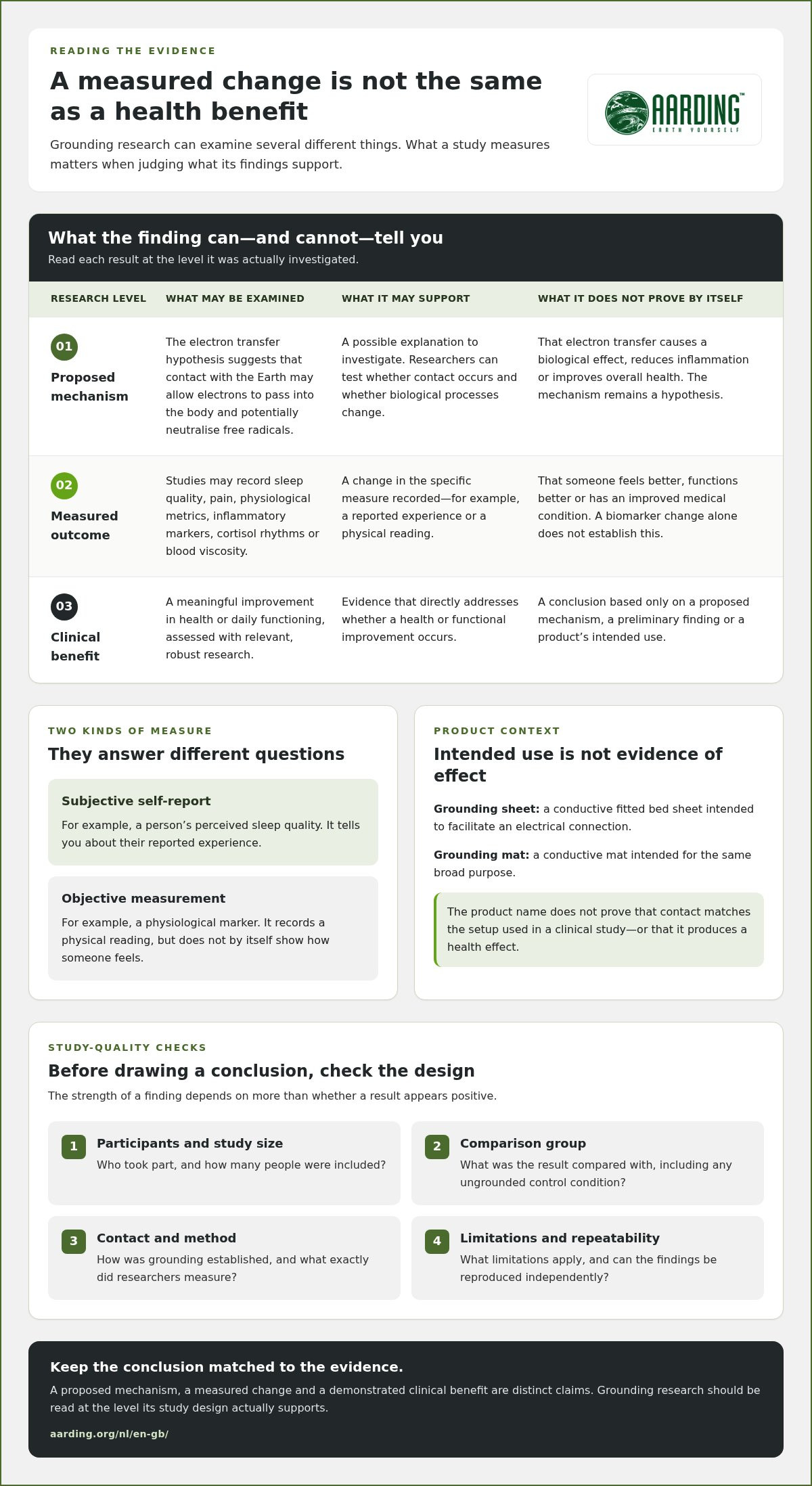
A persuasive claim is not always grounded in solid evidence. Adopting a structured approach to reading research helps distinguish promotional language from verified findings. Look beyond the abstract conclusion to the primary source, the methodology, and the specific outcome measured. This enables you to verify whether a statement matches what researchers actually demonstrated.
A systematic review synthesises multiple studies to offer a broader perspective. However, the label "review" does not automatically confer high quality on the underlying papers. Check when the review was published, which studies were included, and whether they directly relate to the specific claim. A summary that highlights only positive outcomes may not provide the full picture.
Testimonials can describe how an individual feels, but they cannot establish what caused that change. Sleep, pain, and vitality can all be influenced by placebo effects, changes in routine, or concurrent lifestyle adjustments. A personal account may be genuinely meaningful to that individual, but it does not constitute controlled evidence that grounding was the active cause.
Beware of claims that extend far beyond the underlying data. If a study measures a subtle physiological marker, this does not justify assertions about treating or preventing medical conditions. Evaluate scientific evidence for grounding strictly on what was actually tested, rather than on speculative interpretations.
If you have questions regarding symptoms, medication, or medical conditions, consult a qualified healthcare professional. Product descriptions can detail material specifications, but they cannot replace medical advice. If you wish to explore grounding as a personal lifestyle choice, view the grounding products from Aarding whilst maintaining realistic expectations.
Understanding the current state of research helps keep expectations realistic, though it does not dictate whether an item feels comfortable or fits your routine. A grounding sheet, grounding mat, and grounding blanket are product designations for different types of items. Those names do not in themselves validate therapeutic claims. Furthermore, trying a product is not the same as proving its clinical efficacy.
When selecting a product, first consider where you intend to use it. A fitted sheet, flat half-sheet, blanket, or pillowcase is designed for use in bed. A mat might be better suited to areas where you sit or work; options include desk mats and sleeping mats. These are product categories, not guarantees of physical improvements.
Organic cotton is a fabric specification. If natural fibres matter to your personal preference, review the specifications of the individual item. A fabric description says nothing about the physiological efficacy of grounding itself.
Align your choice with your personal preferences and the setting in which you plan to use the item. Consider whether you prefer bedding or a mat for a workspace. Then review the details of that product category. Keep the distinction clear: choosing an item for comfort or convenience is entirely different from drawing conclusions about health benefits.
The scientific evidence for grounding does not guarantee that you will experience a specific outcome. Never use a grounding product as a substitute for professional medical care, and do not postpone necessary medical treatment. If you have concerns about specific symptoms or health conditions, speak with a registered healthcare provider. Product specifications will help you browse available options, but they do not constitute a medical appraisal.
If you wish to explore grounding for yourself, take your time browsing the range to see which category aligns with your routine. Keep your expectations modest: an item may offer comfort and fit your lifestyle, but that does not constitute proof of a physiological health effect.
Research into grounding explores interesting physiological avenues, but current findings do not guarantee therapeutic benefits. When examining scientific evidence for grounding, it is vital to distinguish between a proposed mechanism, a measured biological change, and a proven clinical benefit. Critically evaluate the design and limitations of studies, avoiding broader conclusions than the data support.
A grounding product can be an appealing lifestyle accessory, but it is no replacement for medical treatment. If you have questions regarding health concerns or medical conditions, always consult a qualified healthcare practitioner. Aarding offers a variety of product categories for home and office use, including fitted sheets, half sheets, blankets, pillowcases, and mats. The selection of a product category does not imply clinically proven health effects.
Would you like to explore which category best suits your daily life? View the grounding products from Aarding and form your own impression with balanced, realistic expectations. This approach allows you to remain open-minded whilst making well-considered choices.
There is research exploring potential physiological effects of grounding, but the strength of the evidence varies considerably between studies and endpoints. Consider the sample sizes, the precise parameters measured, and the experimental conditions. A shift in a biomarker does not automatically equate to a tangible health benefit. The scientific evidence for grounding consists primarily of preliminary findings. Independent replication and larger, well-designed clinical trials are required before definitive conclusions can be drawn.
The primary hypothesis proposes that direct contact with the Earth permits the transfer of free electrons into the body. This is a theoretical model, not an established biological fact. Researchers may measure various physiological values and compare them across grounded and ungrounded groups. Such measurements evaluate individual aspects of the hypothesis, but they do not substantiate the complete pathway from contact to clinical benefit. A plausible-sounding mechanism does not prove that a product delivers clinical improvements.
A grounding sheet cannot be considered a proven treatment for medical conditions in the absence of robust, high-quality clinical trials. View it as a personal lifestyle product rather than a substitute for medical therapy or prescribed care. If you have ongoing health concerns or are considering adjustments to your medical regimen, speak with a registered doctor. Assess health claims independently of product names and verify whether sound clinical evidence supports any specific assertion.
In this context, grounding and earthing are largely synonymous terms referring to electrical contact with the surface of the Earth. However, researchers, manufacturers, and authors may use them in slightly different ways. Always check study publications to see how the connection was configured, how conductivity was verified, and what endpoints were evaluated. Sharing a common term does not imply that different studies followed identical protocols or produced comparable results.
Start by consulting the original peer-reviewed publication. Examine the core research question, the cohort size, the presence of an appropriate control group, and the actual endpoints recorded. Note the study duration, any declared conflicts of interest, and whether other independent groups have replicated the findings. A positive outcome in a small sample is not definitive proof. Compare the authors' final conclusions with their actual raw data, taking note of any equivocal or contradictory findings.
Personal testimonials describe subjective experiences, but they cannot prove that grounding caused any observed improvement. Expectation bias, concurrent lifestyle changes, and natural symptom fluctuations can all influence outcomes. An individual report of improved sleep is not the equivalent of a controlled scientific trial designed to rule out confounding factors. Regard testimonials as subjective accounts rather than scientific evidence.
A grounding product does not replace professional medical diagnosis, treatment, or clinical advice. If you choose to use one alongside your normal healthcare routine, maintain realistic expectations and discuss any medical questions with your doctor, particularly if you have underlying conditions or take prescription medication. Aarding supplies wellness products for the home and workspace, including fitted sheets, mats, and blankets. Product descriptions should never be interpreted as personalised medical advice.
Reacties worden goedgekeurd voordat ze verschijnen.