Je winkelwagen is nog leeg



Can a simple form of contact with the earth ever secure an evidence-based place alongside conventional healthcare? The future of grounding in modern medicine does not rely on compelling stories alone, but on rigorous research that tests claims thoroughly. This distinction is vital, especially when personal experiences, preliminary studies, and medical recommendations become blurred online.
It is entirely understandable that you want to know what grounding entails and whether the reported effects on sleep, stress, or recovery are robustly proven. The research is intriguing, but it predominantly consists of small, preliminary studies. Curiosity is therefore warranted, whilst caution remains essential.
In this article, you will discover what is meant by grounding and how researchers examine its potential effects. You will learn how to assess health claims critically and gain insight into the limitations of current evidence, alongside possible next steps in scientific enquiry. You will also read about how grounding as a complementary wellness practice can fit into everyday life, without mistaking it for a medical treatment or a replacement for conventional care.
Why is a simple wellness practice receiving attention within a healthcare setting filled with advanced equipment, diagnostic tools, and pharmaceuticals? Part of the appeal lies in the concept that health is also nurtured through daily lifestyle habits and direct contact with the natural environment. This interest makes grounding a subject worthy of investigation, but it does not, in itself, constitute proof of health benefits.
Grounding refers to direct physical contact between the human body and the earth, such as standing barefoot outdoors on the ground. In wellness contexts, this is often referred to interchangeably as earthing or grounding. The term can also refer to products designed to allow people to explore grounding indoors. Using grounding as a wellness practice is distinct from formulating a scientific hypothesis regarding potential effects, and both differ substantially from a clinically validated medical application.
In everyday language, grounding can simply mean skin contact with the natural surface of the earth. Within the wellness sector, the term also encompasses product categories such as a grounding sheet for a bed, a grounding mat for a relaxation area or workstation, and a grounding blanket. These names describe consumer products, not proven therapeutic interventions. Organic cotton is a general material description that, on its own, indicates nothing about specific health outcomes.
When discussing grounding, it is helpful to clarify what is being referred to: direct contact outdoors, a personal moment of relaxation, or the use of a dedicated product. These situations are fundamentally different from a controlled research setting. A relaxing spell outdoors, for instance, involves rest, physical movement, fresh air, and psychological expectations. Without properly designed research, it is impossible to determine which factor accounts for any perceived change.
There is growing interest in lifestyle, recovery, and complementary approaches to supporting overall wellbeing. Grounding fits neatly into this search by offering a tangible connection to the natural world. Advocates sometimes suggest potential biological mechanisms, but these must be evaluated as hypotheses. A hypothesis provides direction for research, but it is neither a confirmed physiological mechanism nor medical advice.
A general overview of grounding within alternative medicine illustrates how proponents position the practice and highlights that its clinical assessment remains a subject of ongoing debate. Such an overview provides context, but it cannot replace the critical evaluation of individual peer-reviewed studies. For any clinical application, much stronger evidence is required than personal testimonials or general popularity. Research must rigorously evaluate safety, efficacy, and meaningful clinical outcomes for patients.
It is therefore vital to separate three things: grounding as a personal wellness activity, a scientific hypothesis that generates testable questions, and a medical application that demands robust clinical proof. The future of grounding in modern medicine relies heavily on maintaining this distinction. One can remain open-minded and curious whilst staying cautious about bold conclusions, particularly when health claims outpace the available evidence.
A plausible hypothesis is not the same as a confirmed scientific reality. In grounding research, investigators have explored the concept that direct contact with the earth allows an exchange of electrical charges between the ground and the body. Some advocates suggest that free electrons from the earth might act as antioxidants, potentially influencing oxidative stress. However, this remains a theoretical proposal requiring thorough investigation, not an established biological mechanism or a proven clinical outcome in humans.
Even if an idea sounds theoretically sound from a physical or biological standpoint, it does not automatically follow that the process occurs within the human body, can be reliably measured, or has any noticeable impact on health. To substantiate such claims, researchers must precisely describe their methodology, what their instruments measure, and the limitations of their setup. Without this context, mechanistic explanations can easily sound far more definitive than the evidence warrants.
A sound scientific hypothesis leads to a clearly defined research question. Researchers must establish in advance whether they intend to measure surface electrical changes, a specific physiological marker, or an objective clinical outcome. These represent distinct categories of endpoints. A change in an electrical reading does not necessarily mean that an individual feels better or gains any medical advantage.
The measurement technique must also match the research question. Investigating potential electrical shifts requires dependable instruments and transparent documentation of environmental conditions. A control group is essential to assess whether an observed difference is due to the intervention itself or to confounding variables such as rest, expectation bias, or the passage of time. When independent research teams replicate the exact protocol and achieve comparable findings, the results become far more credible.
An early-stage study can identify an intriguing signal and help refine the focus for subsequent research. It cannot, however, definitively prove that a proposed mechanism is accurate, that the effect applies across diverse populations, or that the observed difference is clinically meaningful. Demonstrating those points requires repeated testing, suitable control groups, and an assessment of real-world clinical significance.
Methodological limitations, such as small sample sizes or brief assessment periods, must be evaluated within the context of each specific study rather than used as generic criticisms. It is essential to examine what was actually tested: the cohort, the methodology, the duration, and the precise outcomes. This approach prevents preliminary indicators from being prematurely transformed into generalised health claims.
A biological proposal gains credibility only when human clinical trials rigorously test the mechanism and demonstrate that the outcome has genuine clinical value. This measured intermediate step is fundamental to the future of grounding in modern medicine. In the meantime, you can explore the practice out of personal interest—for example, using grounding products for daily moments of rest—without viewing them as a therapeutic cure.
A personal experience can be genuine and valuable, but it does not clarify what caused a perceived change. An individual might feel calmer following a session of grounding, but whilst that provides grounds for enquiry, it does not prove that grounding was the sole cause or that others will experience the same result. For clinical relevance, the rigour with which a claim has been tested is what truly matters.
It is helpful to weigh different categories of information side by side. Testimonials reflect how people perceive their wellbeing. Observational studies identify associations within existing environments, but they cannot rule out confounding factors. Controlled trials compare groups under pre-defined conditions, providing far stronger evidence regarding cause and effect. Clinical guidelines evaluate the entirety of available scientific evidence and carry considerably more weight than any single study.
Always consult the original peer-reviewed publication rather than relying on summaries or media reports. Examine who participated, the precise interventions applied, the control condition used, and the primary endpoint chosen prior to the trial. Pre-registering an endpoint reduces the risk of researchers highlighting only unexpected, positive findings after the fact. A robust control group helps account for non-specific factors such as expectation bias or simply lying down to rest.
Take note of limitations: the size of the cohort, the duration of the monitoring, and the transparency of the reporting. A single study may suggest a trend, but independent replication is needed to confirm the reliability of the findings. Verify participant numbers and conclusions directly from the primary literature rather than accepting marketing materials or online claims at face value.
Words such as cures, prevents, and proven demand exceptionally strong evidence that directly supports the claim. If participants report sleeping more soundly, this does not automatically prove that grounding altered their sleep architecture. Furthermore, a statistically significant difference does not inherently translate into a noticeable benefit in daily life; the magnitude of the effect, statistical uncertainty, and practical relevance must all be evaluated.
When reading any health claim, ask: is this an anecdote, an observed correlation, or definitive evidence of causation? Does the outcome reflect general wellbeing or a targeted medical treatment? Grounding products can form part of a personal relaxation routine, but they cannot replace a medical diagnosis, treatment, or professional advice. The future of grounding in modern medicine relies on the quality, reproducibility, and clinical relevance of scientific data, rather than the boldness of commercial claims.
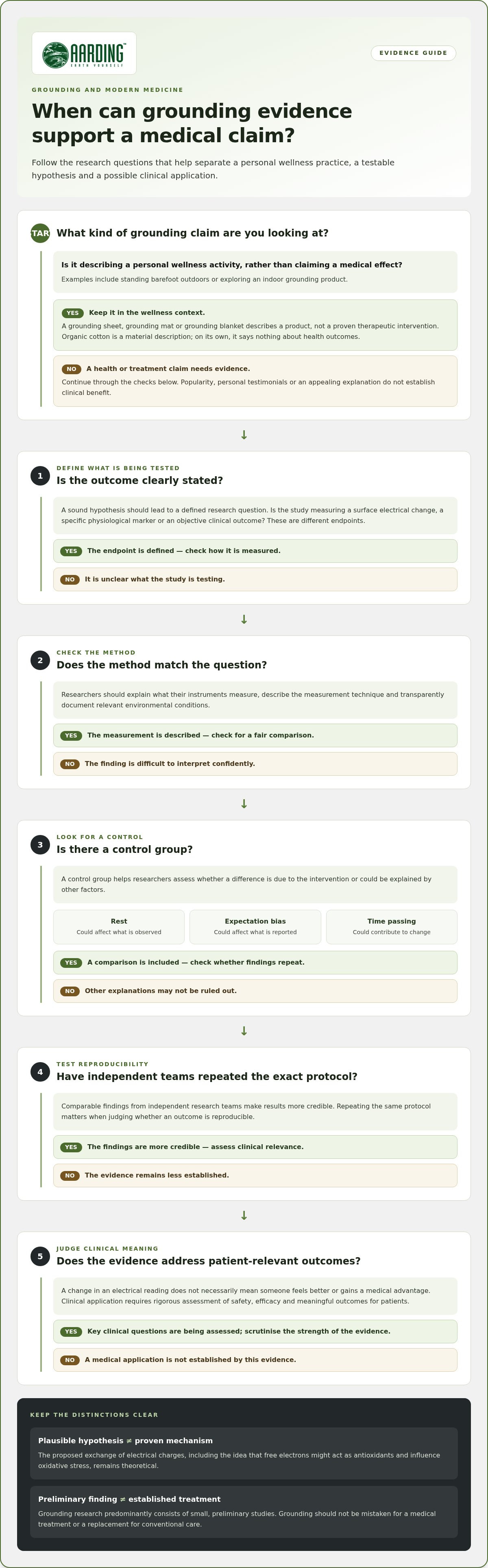
The future of grounding in modern medicine will not be decided by speculative forecasts, but by the calibre of research questions posed and the meticulousness with which scientists seek answers. A plausible hypothesis or an initial finding is merely a starting point. Before clinical guidelines can emerge, researchers must determine precisely what occurs, whether independent teams can replicate the findings, and whether the effects make a meaningful difference to patients.
A rigorous scientific pathway consists of structured stages. First, researchers must articulate a clear, testable hypothesis. Next, they must test it using transparent, reproducible methodologies. Following that, they must evaluate whether any observed difference is clinically meaningful. Finally, independent peer review helps assess the conclusions in light of potential biases and methodological limitations. This process represents a path towards better understanding, not a guarantee that grounding will be integrated into conventional medical care.
A fundamental question is what specific outcome is being assessed and why it matters to the individual. Is it a physiological metric, a self-reported score, or an endpoint that directly influences daily functional capacity? This distinction must be clear from the outset. Standardised methods and consistent measurements are necessary to compare outcomes across different trials, whilst independent replication confirms whether initial observations hold true.
Subsequent research could investigate whether outcomes are reproducible under similar parameters and whether any physiological changes are noticeable to participants. These represent worthwhile research avenues, not confirmation of an established effect. Crucially, future priorities must be guided by dependable, peer-reviewed data rather than commercial enthusiasm or superficial appeal.
Methodological validity, clinical relevance, and therapeutic feasibility are distinct considerations. An outcome might be methodologically sound, yet too subtle or variable to make a practical difference for patients. Even repeated findings do not automatically translate into a clinical guideline. Researchers must also define which patient groups and clinical contexts the results apply to. Only when robust evidence supports these parameters can medical integration be considered.
Until that level of evidence exists, exploratory research remains fundamentally distinct from clinical advice. Always discuss health concerns with a qualified healthcare professional, and never alter an existing treatment plan based on early research claims. If you are interested in grounding as part of your daily downtime, explore grounding products for home and office as supportive wellness items, not medical treatments.
It is entirely possible to approach grounding with genuine curiosity whilst maintaining appropriate scientific caution. You can value a personal moment of rest without assuming that it provides a clinically validated medical cure. For now, the most sensible approach is to view grounding as a lifestyle practice rather than a medical treatment. The future of grounding in modern medicine relies on rigorous research that tests potential mechanisms under controlled conditions.
Keeping this distinction in mind helps you critically evaluate bold claims. An individual experience simply reflects what you felt at a particular moment; it cannot establish causation, nor does it guarantee that someone else will have the same experience. If you have underlying medical conditions or require care, discuss your options with a registered healthcare provider. Never discontinue or delay prescribed medical treatment in order to try grounding.
You can approach grounding as a personal moment of relaxation and mindfulness, without anticipating specific physiological changes. Pay attention to how you feel without drawing sweeping conclusions about physical efficacy. A grounding sheet, grounding mat, or grounding blanket belongs to a product category intended for general wellbeing; none of these terms implies a validated medical outcome.
Grounding products can be integrated into regular daily routines, such as unwinding in bed or sitting at a desk. Options include a fitted sheet, half sheet, blanket, pillowcase, or mat. These products offer a convenient way to explore grounding within your domestic environment, but they carry no guarantees of deeper sleep, symptom alleviation, or specific health benefits.
When trying these products, keep your approach simple and personal: consider where a restful pause fits into your day and note how you feel. View any perceived changes as subjective observations rather than definitive proof of cause and effect. This allows you to remain open to your personal experience without reading more into it than the evidence supports.
Aarding's grounding products are designed to help you integrate grounding into everyday restful moments. You can view Aarding's range of grounding products to see which option suits your sleep or work environment. Regard them purely as wellness accessories, not as substitutes for professional medical diagnosis, advice, or treatment.
A balanced perspective leaves room for curiosity whilst ensuring medical expectations remain grounded in what scientific research actually shows. This is not a dismissal of further enquiry; rather, it ensures personal lifestyle choices and scientific realities remain properly separated.
Any future medical role for grounding depends entirely on reproducible evidence demonstrating clear clinical value and on rigorous professional evaluation.
Looking ahead means remaining open to new questions and emerging insights. The future of grounding in modern medicine will unfold as scientific understanding and methodologies evolve. There is no need to make a definitive judgement today. A thoughtful, open-minded outlook allows you to follow new discoveries whilst taking good care of your everyday wellbeing.
If you would like to explore grounding in your own environment, browse the grounding products from Aarding to see which options best fit your bedroom or workspace.
Stay curious, make mindful choices, and allow scientific insights to develop at their own pace.
Based on current scientific evidence, grounding cannot be classified as a proven medical treatment. If you come across bold claims online, verify whether they refer to peer-reviewed human trials and whether the research genuinely supports those assertions. Always differentiate between a commercial product description and a clinical finding; promotional text on a website is never proof of therapeutic efficacy.
No. If you have concerns about your health, discuss them directly with a qualified healthcare professional rather than modifying your care independently. Note down any claims you have read alongside your specific questions. This allows you to evaluate together whether the information is relevant to your health, without basing decisions regarding medication or follow-ups on promotional material or anecdotal reports.
There is currently no scientific hypothesis that can be considered a definitively proven explanation. When a source describes a biological mechanism, check whether it refers to peer-reviewed evidence or merely a theoretical proposal. Take note of publication dates and subtle phrasing: words such as 'may' or 'could' signify scientific uncertainty, and omitting that nuance does not make the hypothesis any more certain.
A grounding sheet is designed as bedding, such as a fitted sheet, whilst a grounding mat is meant to be placed under your feet or hands, often at a desk. When choosing, consider where you prefer to spend your quiet time and how much space you have. The product name describes its physical format, not a difference in proven therapeutic efficacy; you should not assume that one is better suited to a specific health complaint than the other.
Always review the original scientific paper before accepting or sharing its conclusions. Check whether the stated conclusions match the actual data and whether the authors clearly differentiate between their findings and areas that require further study. Look to see whether independent trials have subsequently confirmed the results; an eye-catching headline is never a substitute for methodological appraisal.
You can certainly use a grounding product at home as part of your personal relaxation routine. Keep this entirely separate from medical decisions: note any changes or questions you have and discuss them with your doctor if they concern your health. Never alter your prescribed care to test a product. This ensures a clear boundary between your lifestyle choices and your medical treatment plan.
Reacties worden goedgekeurd voordat ze verschijnen.