Your Cart is Empty



Can grounding make a noticeable difference to your skin, or do online claims promise more than the evidence can substantiate? It is a natural question to ask. Skin contact with a conductive product, such as a grounding sheet, sounds simple, but what that actually means for your skin is far less certain.
You do not have to dismiss hopeful claims out of hand, but it is sensible to weigh them against the available research. Studies into grounding remain limited. Early findings, therefore, do not constitute proof that grounding improves the skin or treats dermatological conditions.
In this article, you will learn how skin contact works during grounding, what research can and cannot tell us about potential skin effects, and how to evaluate claims with care. You will also find practical points to consider if you are contemplating a grounding product. This will enable you to make an informed decision without confusing a wellness claim with medical treatment.
Within this practice, grounding means establishing physical contact between your body and the earth, whether outside on the bare ground or indoors using a purpose-made conductive product. The term grounding (or earthing) describes this connection. When exploring grounding and the effects on the skin, it is essential to keep two things distinct: skin contact is a physical connection, but in itself, it does not demonstrate a biological health benefit.
Grounding is simply the contact of your skin with the earth or a designated conductive product. That describes the method, not a proven dermatological benefit. Keeping this in mind prevents you from mistaking instructions on how to use a product for proof that it will change your skin.
With the grounding method, a part of your skin touches the earth or a conductive surface designed for this purpose. Outdoors, this might occur when standing barefoot on the grass or soil. Indoors, skin contact can take place via a sheet, blanket, pillowcase, or mat. The settings differ, but both involve contact with a conductive surface.
Conductive materials can transfer electrical charge. This describes the intended physical property of the material, not a therapeutic effect on your skin. Product compositions may vary. The crucial distinction is that whilst contact confirms you are applying the method, it does not prove that your skin barrier is enhanced, inflammation is reduced, or wound healing is accelerated.
The skin acts as a protective barrier. The epidermis, the outermost layer of the skin, helps retain moisture and shields the body from external environmental factors. This is a fundamental aspect of normal skin biology. The fact that the skin serves as an interface between the body and its environment does not automatically mean that contact with a conductive surface alters that barrier.
Claims regarding skin repair or inflammation go far beyond describing simple skin contact. To determine whether grounding genuinely influences such outcomes, human clinical research is needed that directly measures the skin itself and accounts for confounding variables. A proposed biological mechanism may offer a valid research question, but it cannot substitute for clinical evidence.
Keep the core concept clear: skin contact merely explains how grounding is carried out in practice. Whether that contact causes measurable changes in the skin is an entirely separate matter. This distinction allows you to view information about grounding and skin health with healthy interest alongside a sensible, grounded perspective.
Discussions around grounding frequently refer to an electrical connection between the human body and the earth. Proponents hypothesise that contact with the earth can influence electrical charges within the body. This explanation attempts to describe how grounding might theoretically operate, but it does not prove that your skin undergoes any actual physiological change as a result.
A potential biological pathway is therefore merely a starting point for scientific inquiry, not a definitive conclusion. This distinction is vital when considering grounding and the effects on the skin: an explanation may sound plausible, yet a noticeable or measurable benefit to the skin remains unproven.
In general terms, an electrical connection refers to physical contact with the ground, either directly outdoors or through a product intended for grounding contact. In descriptions of the method, hypotheses are sometimes put forward suggesting that electrons from the earth may influence internal bodily processes. What is grounding? provides an accessible summary of this line of thought whilst also noting the limited nature of current research.
View such biomedical explanations as propositions that warrant careful verification of sources. Does a source describe a theoretical hypothesis, laboratory findings, or clinical skin outcomes measured in human subjects? These represent very different levels of evidence. Describing an electrical connection does not, on its own, demonstrate that skin cells, the skin barrier, or any dermatological complaint are altered.
To substantiate an effect on the skin, researchers must measure relevant clinical outcomes in human trials. Examples include predetermined changes in skin condition alongside a control comparison that allows researchers to determine whether observed changes were genuinely caused by grounding. Without such rigorous study designs, any observed difference cannot simply be attributed to earthing contact.
Furthermore, the skin is influenced by numerous factors, including skincare routines, environmental conditions, and overall personal health. If a skin complaint improves whilst someone concurrently adopts a new lifestyle habit, this correlation does not prove which factor caused the change. It is far more accurate to speak of a potential association rather than a verified cause.
A plausible mechanism may illustrate how an effect could theoretically occur, but only rigorous human clinical trials can establish whether grounding provides a clinically relevant skin benefit. Approaching the topic this way leaves room for future scientific inquiry without presenting a hypothesis as a medical treatment. If you wish to see which grounding products for home and office are designed for conductive contact, view them as practical tools for grounding, not as proven dermatological therapies.
The central question is not merely whether grounding correlates with physiological changes in the body, but whether scientific research actually measures distinct changes in the skin. Findings regarding stress markers, sleep quality, or general systemic inflammatory indicators do not automatically constitute evidence of an improved skin barrier, reduced irritation, or faster tissue repair. When examining grounding and the effects on the skin, one must scrutinise skin-specific outcomes and the methodologies used to assess them.
First, examine precisely what the researchers measured. A dermatological study might evaluate the epidermal barrier function, irritation levels, wound healing rates, or another predefined skin outcome. The method of evaluation is equally important. When a participant reports that their skin feels softer or calmer, this represents a subjective personal experience. While valuable, it is not equivalent to an objective, clinical skin measurement.
Check also who participated in the study and whether an appropriate control group was included. A trial looking at a different physiological marker, such as blood chemistry, may generate a hypothesis, but it does not demonstrate that the skin is affected. Without verifiable data regarding participants, methodology, and measured endpoints, it is prudent to refrain from claiming specific skin improvements or repeating statistical assertions.
A rigorous study transparently details its design, participant demographics, measurement techniques, and limitations. A control group helps researchers determine whether an observed outcome is linked to the intervention being studied or to external variables. It is also important to consider whether the study was conducted independently and whether potential conflicts of interest are disclosed.
Small or uncontrolled trials may provide intriguing preliminary insights, but they rarely offer a robust foundation for establishing cause and effect. Participants may alter their skincare regimens at the same time, skin conditions naturally fluctuate over time, and personal expectations can strongly influence perceived changes. Laboratory experiments and theoretical models can explore biological questions, but they cannot replace clinical trials in humans.
Make sure, therefore, to differentiate between general bodily responses and directly measured dermatological effects. Without well-documented, reproducible studies assessing human skin outcomes, definitive conclusions are unwarranted. This does not rule out potential benefits, but it does mean certainty remains very limited.
Current evidence is insufficient to consider grounding a proven method for improving skin health. Reliable conclusions require well-designed studies that directly measure skin outcomes in human subjects. Approach new claims with a few critical questions in mind: what exactly was measured, in whom, and do the findings show a genuine skin change or merely a theoretical explanation?
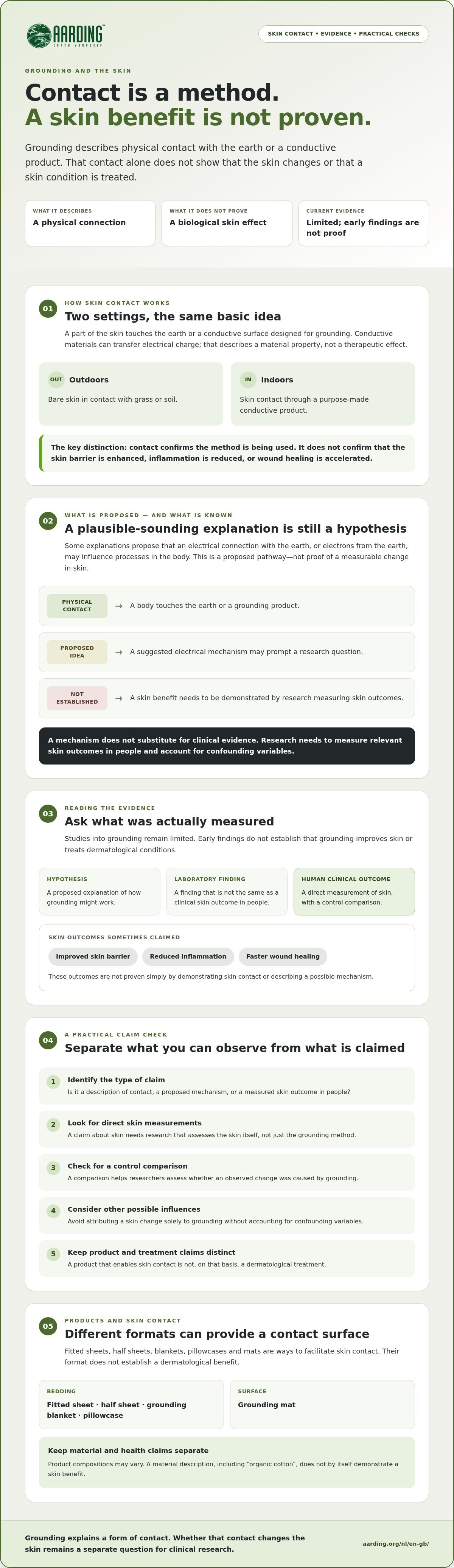
A grounding product can easily become part of your daily routine, but it should not be viewed as a remedy for a skin condition. Assessing grounding and the effects on the skin requires a balanced approach: scrutinise claims objectively, follow the manufacturer's usage instructions, and monitor any changes methodically. This prevents you from immediately attributing every shift in your skin's condition to a single new habit.
Use this practical checklist to evaluate your use and manage your expectations sensibly:
These steps do not turn product use into a clinical trial or treatment. Rather, they help you differentiate between subjective personal experience and what scientific research can actually prove.
Grounding products do not diagnose conditions and are not a substitute for professional medical assessment or treatment. Always discuss severe, persistent, or rapidly changing skin problems with a qualified healthcare professional. If you are unsure about a skin issue, seeking medical advice is far wiser than waiting to see if grounding makes a difference. This information is educational and does not constitute personalised medical advice.
If you wish to use a grounding product for contact whilst resting or during daily tasks, take a look at our grounding products for home and office.
Grounding products can provide a straightforward way to maintain contact with a designated conductive surface at home or in the office. The design of the product and when you choose to use it are practical decisions. They do not dictate whether your skin will improve. This distinction remains crucial when discussing grounding and the effects on the skin: using a product does not constitute proof of a dermatological benefit.
For use during sleep, there are several product categories, including fitted sheets, half sheets, blankets, and pillowcases. In English-language discussions, similar items are often referred to as a grounding sheet or grounding blanket. Which option you consider depends on the setting and the time of day that best fits your routine. The product name alone says nothing about its biological effect on your skin.
For daytime routines, conductive mats are available, including universal mats and desk mats. Sleep mats are also available. Thus, the term grounding mat refers to a mat designed specifically for grounding contact. Consult individual product details to determine the exact type. Avoid making assumptions about attributes such as materials, dimensions, or connections unless they are explicitly confirmed.
When selecting a product, begin by considering where and when you intend to use it: whilst resting, during sleep, or throughout the working day. This allows you to choose a practical format that integrates smoothly into your life without viewing it as a medical skin intervention. Always consult the product information for specific usage guidance.
Evaluate product descriptions based on what is factually stated. A product may be designed to facilitate grounding contact, but that is entirely different from a demonstrated clinical effect on the skin. Notice whether claims of skin benefits are substantiated by verifiable human trials, or whether they merely reflect general hopes. Similarly, check material specifications: organic cotton applies only when specifically certified for that product.
This approach allows you to choose a product format tailored to your daily lifestyle whilst keeping your expectations regarding your skin measured and realistic. Grounding products are not medical skincare treatments and cannot replace professional dermatological care. If you would like to explore the different options available, you can browse the grounding products from Aarding.
When evaluating grounding and the effects on the skin, the key distinction is straightforward: skin contact describes how the practice is applied, not proof of a clinical skin benefit. Proposed biological mechanisms are intriguing, but drawing firm conclusions requires robust clinical research directly measuring human skin outcomes.
Treat a grounding product as a practical tool for earthing contact, rather than an intervention for skin conditions. If your skin undergoes changes, do not automatically attribute them to grounding. Keep your daily routine consistent, and always consult a doctor or dermatologist if you experience persistent, severe, or worsening symptoms.
Aarding offers dedicated product categories for sleep and daytime routines, including fitted sheets, blankets, pillowcases, and various mats. These designs can complement your daily habits without implying unverified promises of skin improvement. Explore Aarding's range of grounding products and select the format that suits your lifestyle.
A sensible, informed choice starts with healthy curiosity paired with an objective look at the scientific evidence. That way, you can support your general wellbeing without expecting more from a product than research can substantiate.
No, at present there is insufficient conclusive scientific evidence to state that grounding verifiably improves the skin. When evaluating grounding and the effects on the skin, it is essential to distinguish between a proposed biological theory and measured clinical outcomes in humans. Studies examining other physiological markers do not automatically demonstrate an effect on the skin. Always check whether research directly measures dermatological changes and evaluate the rigour of the study design.
This has not been proven as a clinical treatment for eczema or cutaneous inflammation. Whilst there are hypotheses suggesting how grounding might interact with bodily processes, they do not establish that skin conditions improve. Furthermore, eczema has many varied causes and triggers. Do not use a grounding product as a substitute for dermatological care or prescribed medication. Always discuss persistent or worsening symptoms with a healthcare professional, especially if you are uncertain about the cause.
A grounding sheet is designed as a conductive surface with which you maintain contact whilst lying down, typically through bare skin touching the fabric. This describes its intended physical use, not a verified dermatological effect. Follow the product guidance for appropriate use and avoid drawing medical conclusions from physical contact alone. Establishing a true skin benefit requires clinical trials that directly assess relevant skin outcomes in humans whilst controlling for alternative factors.
There is no evidence to guarantee an identical outcome for every type of sensitive skin. Always read the instructions provided with your chosen product and pay close attention to how your skin responds. Discontinue use immediately if you experience irritation or discomfort. Skin sensitivity can stem from numerous factors, so do not immediately assume a reaction is proof for or against grounding. If irritation persists, consult a healthcare professional before attributing any skin changes to the product.
The product provides contact with a conductive surface, but it is not proven to treat skin conditions. Your symptoms may remain unchanged or fluctuate for unrelated reasons. Do not alter your prescribed skincare routine without medical advice. If you wish to observe your experience, avoid changing other skincare products or lifestyle habits at the same time. Discontinue use if discomfort arises. Have severe, persistent, or rapidly changing skin problems assessed by a healthcare professional rather than waiting for a potential effect.
No. A grounding mat is designed to facilitate grounding contact; it is not a substitute for skincare products, a medical diagnosis, or prescribed treatments. Never use a mat as a reason to stop medical therapies or delay professional consultation. If you have skin complaints that persist, worsen, or change rapidly, contact a qualified doctor. Product use and medical care serve entirely different purposes, and a theoretical mechanism does not mean a condition is being treated.
For use during sleep, Aarding provides product categories including fitted sheets, half sheets, blankets, pillowcases, and sleep mats. The format helps you decide what fits best into your night-time routine, but it does not imply dermatological improvement or therapeutic properties. Check the individual product specifications for its intended use. Specific material qualities are not identical across all ranges, so consult the product details rather than making unverified assumptions.
Comments will be approved before showing up.