Your Cart is Empty



What if recovering from profound exhaustion did not call for yet another intensive action plan, but rather for biological discharge? When your battery is completely drained, every additional exertion feels insurmountable. You are likely experiencing an overactive nervous system, persistent physical tension, and disrupted sleep, leaving your cells struggling to regenerate. It is precisely at this breaking point that grounding for burnout offers gentle, effortless support for both body and mind.
You know how frustrating it is when rest alone no longer feels sufficient to truly unwind. In this article, you will discover how direct contact with the earth biologically influences your nervous system and helps to gradually normalise a disrupted cortisol rhythm. We explore how gentle grounding, such as using a grounding sheet crafted from breathable organic cotton, supports your overnight regeneration without requiring any active effort on your part. In doing so, you will find a straightforward, passive routine that naturally bolsters your recovery process.
Many people still perceive burnout as a purely psychological issue. The reality, however, is that burnout represents a state of profound physiological exhaustion caused by the prolonged overactivation of your neuroendocrine stress response. When workplace pressure or emotional strain persists for months, the communication between your brain and your adrenal glands becomes dysregulated. The body continuously produces steroid hormones, leading to an increase in oxidative stress and systemic, low-grade inflammation throughout your tissues. This condition, closely linked to the broader burnout syndrome, causes recovery to stall because your body is biochemically unable to return to a restful state on its own. As a result, grounding for burnout becomes a valuable, non-invasive approach to help disrupt this entrenched pattern.
Your autonomic nervous system regulates involuntary bodily functions through two primary branches: the sympathetic and the parasympathetic. Under sustained stress, the sympathetic nervous system retains dominance:
Anyone who has experienced burnout will recognise this: you spend hours lying on the sofa, yet you get up feeling just as exhausted. Sitting passively does not automatically mean your tissues and cells are relaxing. Due to the body's constant biochemical alarm state, muscle fibres remain taut and microcirculation stays constricted. Consequently, metabolic waste products are cleared more slowly, and oxygen and vital nutrients struggle to reach your cells. Without a physiological shift, the nervous system remains on high alert. This is precisely why deliberate grounding for burnout can provide a reassuring physical signal, communicating to your body at a cellular level that the immediate threat has passed.
The earth possesses a natural, subtle negative electrical charge that is continuously replenished by atmospheric activity. When your bare skin comes into contact with the ground, your body synchronises with this electrical potential. During periods of chronic stress, positively charged particles known as free radicals accumulate within bodily tissues. Grounding acts as a conductive bridge: free electrons flow inward from the earth to neutralise this oxidative charge. This biophysical mechanism provides your nervous system with the opportunity to release the continuous fight-or-flight response and transition back into restorative rest-and-digest mode. For this reason, grounding for burnout serves as a potent physical intervention that requires no active expenditure of energy.
As soon as physical contact with the earth is established, the static electrical voltage on your skin drops almost instantaneously to zero. The influx of electrons binds to free radicals, gently quelling acute and low-grade inflammation within overworked muscles. This requires no willpower or mental concentration; it is a purely physical equalisation. Your muscles relax more deeply and your circulation improves without the need for demanding breathing exercises or exhausting routines.
This biological discharge exerts an immediate influence on the vagus nerve, the primary nerve tract of the parasympathetic recovery system. Clinical observations indicate that grounding enhances heart rate variability (HRV) within minutes:
Those looking for practical ways to ground can simply stand barefoot on the grass to experience this effect. If you would like to enjoy this soothing influence indoors during your moments of rest, explore aarding.org/nl for gentle ways to support your body daily. In doing so, you foster a stable environment for recovery in an accessible manner—precisely what an exhausted body needs.
Clinical research into sleeping grounded demonstrates that bioelectrical connection with the earth exerts a direct effect on our endocrine function. Under healthy conditions, cortisol adheres to a distinct 24-hour circadian rhythm: the hormone peaks upon waking to foster alertness, before declining throughout the evening to allow melatonin to take over. During burnout, this hypothalamic-pituitary-adrenal (HPA) axis often becomes structurally dysregulated. The result is an inverted cortisol curve, where stress hormones surge in the middle of the night. You find yourself wide awake with palpitations, or jolting awake at three in the morning with a racing mind. Targeted grounding for burnout helps to gradually harmonise these erratic hormone levels.
Research by Ghaly and Teplitz, published in the Journal of Alternative and Complementary Medicine, demonstrated that sleeping grounded over an eight-week period led to a measurable resynchronisation of the 24-hour cortisol profile. Among all participants with disrupted curves, nocturnal cortisol levels dropped significantly. This establishes favourable biological conditions for restorative sleep:
Overnight recovery depends heavily on the slow brainwaves characteristic of deep, non-REM sleep. It is during these restorative phases that the glymphatic system in the brain activates to flush away cellular waste and repair tissue damage. Chronic hyperarousal frequently curtails these deep stages prematurely. Grounding extends the continuous time spent in these rejuvenating phases of sleep. By releasing physical muscular tension and dampening nocturnal alarm signals, grounding for burnout underpins deeper physiological repair. You wake in the morning with less muscular stiffness and a calmer nervous system, laying a solid foundation for gradual regeneration.
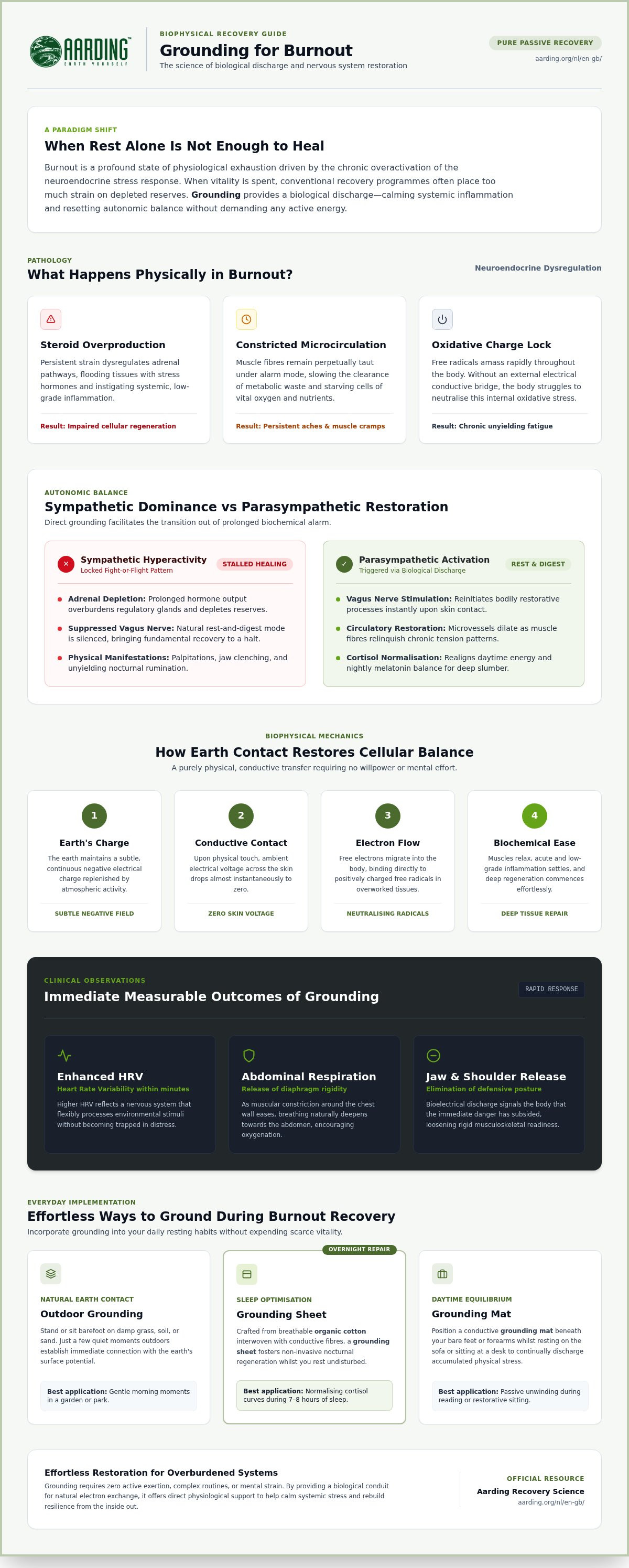
When grappling with profound exhaustion, one rarely has the stamina for elaborate recovery regimens or lengthy walks in the woods. Nor is that necessary. Recovering from sustained overload calls for slowing down and embracing gentleness. By introducing grounding for burnout gradually, you afford your overstimulated nervous system the space to adapt step by step to physiological discharge. You can easily divide this process into four straightforward stages:
The simplest way to start is by sitting on a garden chair with your bare feet on the grass. Damp lawn and moist earth offer superb natural conductivity for free electrons. Be sure to seek out a peaceful spot where you are not required to engage socially or process excessive stimulation. If the weather is bleak or you feel too tired to step outside, do not force yourself. Compulsion is entirely counterproductive for an exhausted nervous system, as any feeling of obligation triggers the sympathetic response once more.
A body that has operated in survival mode for months on end can sometimes react quite intensely to sudden physiological relaxation. As persistent vasoconstriction recedes and blood flow improves, you might feel a mild tingling in your limbs or a sudden wave of deep drowsiness. This does not indicate a setback, but rather signals that tissues are finally releasing long-held tension. Give your body the time it needs to adjust to this biological transition. If you would like to explore how to extend this gentle approach effortlessly into your living room or bedroom, discover the possibilities at aarding.org/nl to see which supportive solutions match your current stage of recovery. This ensures that grounding for burnout remains a soothing lifestyle intervention tailored to your present energy levels.
When chronic fatigue colours your daily life, the energy required to go outside every day is often lacking. Fortunately, connecting with the earth does not need to be complicated. Indoor grounding enables you to discharge your body regularly without requiring you to overhaul your day-to-day routine. By connecting conductive materials to the earth via a safe, designated connection point, you benefit from the very same grounding potential found out in nature. In this way, grounding for burnout becomes an entirely passive lifestyle practice that gently underpins your recovery while you simply rest.
The most natural way to integrate grounding is through the night. A grounding sheet, crafted from breathable organic cotton woven with fine silver thread, acts as a dependable conductor between your body and the earth. This offers distinct advantages for an exhausted system:
During the day, you can also incorporate restorative moments effortlessly, without expending willpower. A versatile grounding mat can simply be placed beneath your bare feet while you sit on the sofa, read a book, or rest quietly. If you are seeking added comfort, a soft grounding blanket wraps you in a comforting layer that helps dissipate built-up muscular tension. By giving these gentle tools a permanent place in your home, you create regular breathing spaces for your nervous system. Grounding for burnout demands no active energy in this manner, but instead offers your fatigued body a safe harbour to return, step by step, to a state of healthy equilibrium.
True recovery from deep exhaustion does not require yet another strenuous effort; it requires relieving constant physiological overstimulation. By discharging your body through contact with the earth, your overworked nervous system is afforded the biological leeway to shift from sustained high alert into profound rest. This assists in gradually synchronising your natural cortisol profile and establishes the ideal conditions for a night of truly restorative sleep.
As a specialist in certified earthing technology since 2012, Aarding makes this connection safe and accessible in the comfort of your own bedroom. Made with skin-friendly organic cotton interwoven with pure antibacterial silver thread, this beneficial grounding integrates effortlessly into your regular sleep routine without requiring any discipline. That is precisely what makes grounding for burnout such an invaluable, restorative lifestyle practice alongside any medical or psychological guidance. Discover how sleeping gently grounded can support your recovery and offer your body the serene environment it needs to recharge in complete peace.
No, grounding is a supportive lifestyle practice and should never replace medical or psychological care. It helps calm an overstimulated nervous system and relieves physical tension, allowing your body to rest more deeply. If you are experiencing severe exhaustion, always consult your GP or a healthcare specialist for professional guidance. Aarding does not provide medical consultations, focusing exclusively on offering safe, non-invasive support for your daily recovery environment.
Many individuals notice a subtle decrease in muscle tension and deeper abdominal breathing within just a few minutes. For long-term physiological changes, such as harmonising a dysregulated cortisol profile, daily consistency is key. Clinical observations show that sleeping grounded on a conductive surface, such as a grounding sheet, yields noticeable improvements in sleep quality and circadian rhythms after approximately eight weeks.
Yes, indoor grounding via a properly grounded wall socket is entirely safe and consumes no mains electricity. The specialised adapter connects solely to the earth pin or earth contact of the socket, not to the live electrical terminals. Furthermore, the conductive connection lead is fitted with an integrated 100 kΩ safety resistor. This ensures that only subtle free electrons can flow, preventing any mains electricity from reaching your body.
Biologically speaking, you cannot over-ground; however, an exhausted body can be sensitive to sudden, deep relaxation. When tissues that have been tense for months finally release that strain, you may experience temporary drowsiness. For this reason, when starting grounding for burnout, it is sensible to begin gently with fifteen-minute sessions on a grounding mat. Once your system adapts to this state of rest, you can extend your contact effortlessly.
Most people experience a gentle warmth, light tingling sensations in the feet, or a spontaneous easing of tension in the neck and jaw. As static tension on the skin drops and peripheral circulation improves, cold feet often feel comfortably warm much faster. Your breathing settles deeper into your abdomen. At times, you may simply notice a pleasant, profound sleepiness as your body feels safe enough to let go of its chronic alertness.
Night-time is the body's dedicated biological window for tissue repair and immune system recovery. Sleeping grounded on a sheet made from breathable organic cotton woven with pure silver requires no discipline or behavioural changes whatsoever. You benefit from several uninterrupted hours of free electron transfer during your deepest stages of sleep. That is why nocturnal grounding for burnout is particularly effective: it strengthens your innate restorative capacity without drawing on your active energy reserves.
Direct contact between bare skin and the conductive material is the most direct approach, yet grounding also works effectively through thin layers of natural fibres. Body heat and microscopic perspiration quickly create sufficient conductivity through cotton socks or pyjamas. In contrast, thick synthetic garments or rubber-soled footwear will block electron transfer entirely. For the most restorative results, direct skin contact remains the ideal choice.
Comments will be approved before showing up.