Your Cart is Empty



You cannot judge the ethics of producing grounding products from a single material claim. Even when an item is made from organic cotton, that in itself reveals little about the origin of the fibres, working conditions in the factory, or overall durability. When choosing a grounding sheet, grounding mat, or grounding blanket, there is far more to weigh up than merely the fabric listed on the label.
How do you assess whether grounding products are ethically produced when supplier and manufacturing information is limited? Terms such as ‘sustainable’ and ‘natural’ are only meaningful when accompanied by verifiable details or independent evidence. Moreover, each certification has its own scope: some focus purely on raw fibres, whilst others address hazardous substances or fair labour practices.
In this article, you will discover how to critically evaluate manufacturing claims without taking unproven health or sustainability promises at face value. We examine material provenance, manufacturing, certifications, and lifespan across various items—from sheets and pillowcases to mats and blankets. This provides a practical framework for comparing claims and making a well-considered choice aligned with your values, from everyday use right through to disposal.
Ethical manufacturing goes far beyond the material you can see or touch. With a grounding product, the origin of raw materials, the people making it, transparency across the supply chain, and expected lifespan all play crucial roles. These are distinct aspects, yet together they paint a clearer picture of whether a product genuinely aligns with your personal values.
Responsible manufacturing requires attention to people, materials, transparency, and product longevity that helps curb needless waste. Use these focal points as your benchmark when assessing claims. For instance, a product might incorporate a material with traceable origin, yet disclose virtually nothing about the subsequent processing steps. Ethical production is never synonymous with a single sustainability feature.
It is equally vital to distinguish between ethics, environmental impact, and health benefits. Ethical production centres on fair treatment, workplace safety, and corporate responsibility across the supply chain. Environmental impact addresses the consequences of material selection, processing, transit, and disposal. An assertion regarding well-being or product use provides no insight into these operational areas. Conscious purchasing, or ethical consumerism, therefore begins by comparing different categories of evidence side by side.
Consider a grounding sheet or grounding blanket. Examine what details are disclosed regarding the textiles and conductive components, what secondary materials are used, and what manufacturing steps are required to assemble the finished item. Working conditions, occupational health and safety, and supply chain accountability are all critical aspects. Without verifiable documentation, these remain open questions. One simply cannot infer such qualities from the outward look of an item.
Pay careful attention to the exact scope of every claim. Information concerning a single fabric does not automatically shed light on assembly, packaging, or auxiliary fittings. After all, a finished product consists of far more than its most visible material.
Assess statements regarding intended use or potential well-being effects entirely separately from production details. Even a compelling claim offers no proof of where materials originated, under what conditions workers laboured, or how long an item will endure. Never accept a health promise as a substitute for verifiable supply chain data. Grounding is not a medical treatment, and a marketing claim does not constitute evidence of a clinical outcome.
Place claims side by side: what is specifically being asserted, which component does the statement cover, and what documentation is supplied? If a brand merely highlights a natural-sounding fabric, you still lack a complete overview of manufacturing. By answering these questions methodically, you can readily separate verified facts from marketing ambiguity.
A single material reveals only a fraction of the full picture. Assess a grounding sheet, grounding mat, or grounding blanket by examining each link in the chain: from raw material harvesting and refinement through to assembly, packaging, shipping, daily use, and eventual disposal. Each stage raises distinct considerations. For example, knowing the origins of a fabric tells you nothing about how conductive components were fabricated or how the item is boxed.
Traceability matters at every stage: only by examining the entire chain can you see where transparent information exists and where blind spots remain. This serves as a practical baseline when weighing the ethics of producing grounding products. Clarity surrounding one specific part does not automatically validate the rest.
First, inspect the available information regarding textiles and conductive elements. Does the manufacturer merely state the material name, or do they clarify where it was sourced and how it was treated? For fabrics, consider spinning, weaving, dyeing, and finishing. Dyes and chemical treatments are distinct production stages. A statement regarding the raw fibre does not explain how those subsequent processes were handled.
The term organic cotton describes a characteristic of the cotton fibre, but it offers no guarantee regarding how other parts of the item were manufactured. An established standard such as the Global Organic Textile Standard provides a helpful reference point for organic textile claims. Even so, examine the precise scope of the standard to verify whether the certificate covers only raw materials or encompasses subsequent processing. Never draw a broader conclusion than the available documentation supports.
Assess conductive materials with equal scrutiny. Seek out clear details regarding their provenance, processing methods, and surface treatments. Do not assume a specific composition if it is not explicitly disclosed. Note absent details as unknown rather than making assumptions.
Following raw material extraction come assembly and packaging. Relevant questions include where the item is assembled, how labour standards are monitored, and how corporate responsibility is managed across subcontractors. A generic statement about responsible procurement offers minimal insight if it fails to identify which suppliers or production facilities are covered.
Practical environmental disclosures also vary by stage. Does the brand share data on energy use during processing, material efficiency during cutting, or packaging choices? These are areas to investigate rather than attributes to take on trust. Packaging also influences protection during transit and dictates what packaging waste must be disposed of afterwards.
Transport warrants scrutiny, but represents merely one piece of the puzzle. A short freight distance does not automatically resolve questions regarding raw materials, fair wages, or durability. Therefore, examine care guidance, expected lifespan, and end-of-life recycling options. You can apply these identical supply chain questions across the varied grounding product categories from Aarding, including sheets, mats, and blankets, without making premature assumptions about sustainability.
A product page may feature descriptors like ‘natural’, ‘green’, or ‘sustainable’. Without precise explanation, such terms carry little weight: you cannot discern which component is referenced, how the claim was verified, or what empirical evidence backs it up. Therefore, compare not just the terminology, but the scope and substantiation provided.
A transparent claim can be traced back to solid evidence: you can see what it applies to, who verified it, and what falls outside its remit. This is an essential mindset when evaluating grounding products. A quality mark can be informative, but only within the exact parameters it tests. One standard might evaluate fabric safety, whilst another appraises labour conditions. No single badge answers every question across a manufacturing chain.
| Claim | What evidence aligns with it? | Scope | What question remains? |
|---|---|---|---|
| ‘Made with organic cotton’ | Product documentation detailing the proportion and provenance of the cotton, supported by certification | The specified textile material | How are auxiliary components, treatments, and final assembly managed? |
| ‘Tested for harmful substances’ | A laboratory test report or certification specifying examined product components and testing parameters | The tested substances and parts | What does this say about workplace conditions or raw material provenance? |
| ‘Responsibly produced’ | Detailed disclosures concerning manufacturing sites, labour standards, and auditing protocols | Strictly the facilities and processes explicitly documented | Are upstream raw material suppliers and third parties included? |
| ‘Sustainable’ | A defined, measurable breakdown with verifiable data detailing the claimed environmental impact | The specific parameter measured | Does the claim apply to the product, its packaging, or the entire supply chain? |
Look for clearly named material grades, provenance documentation, and an explicit statement of what a certification covers. Product-level documentation provides insights into the physical item itself. A broad corporate mission statement does not automatically apply to every item in a catalogue. The OECD Guidelines can serve as a benchmark for corporate responsibility and supply chain due diligence, but they do not constitute a consumer product certification. Always verify what evidence is presented.
Broad statements lacking measurable criteria, defined boundaries, or supporting evidence are reason to scrutinise claims further. However, ambiguous claims alone do not mean a brand is intentionally deceptive. Appraise the product presentation as a whole: green packaging or one responsibly sourced fibre tells you little about the remaining components. Note what is substantiated and what remains vague. This ensures you compare grounding products based on facts rather than marketing slogans.
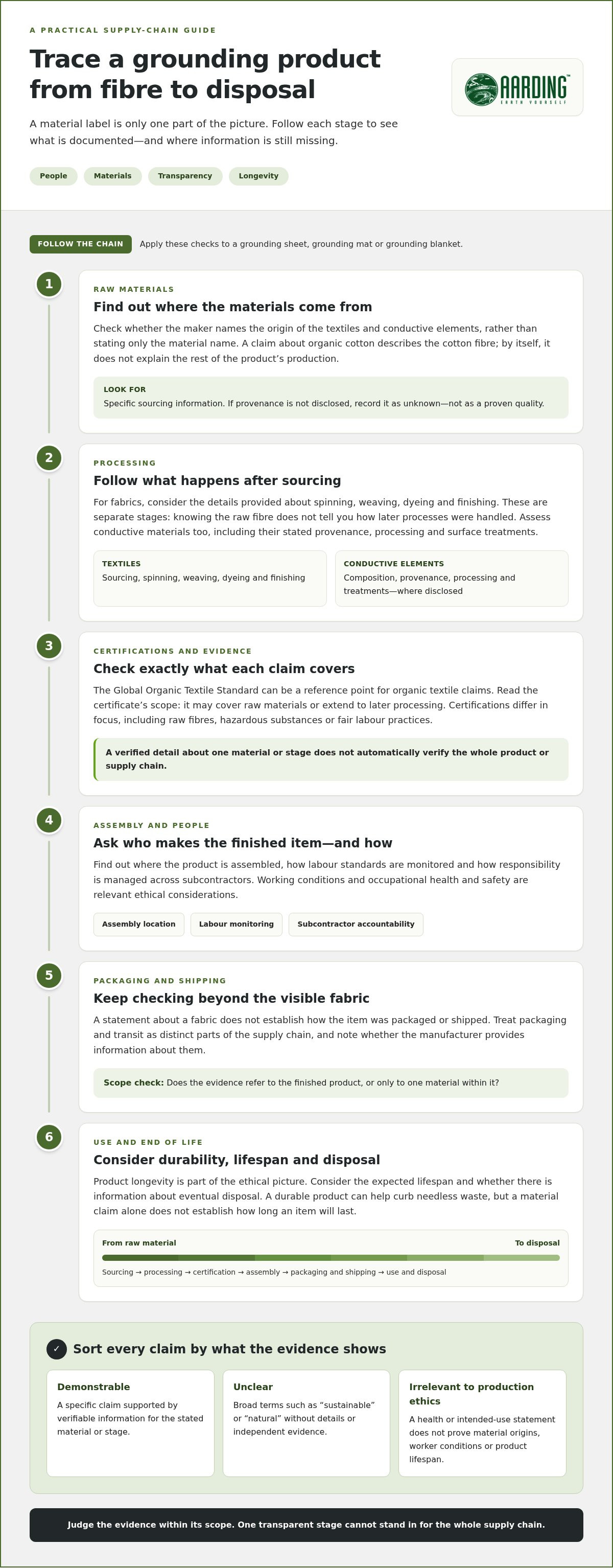
Making a conscious choice does not require immediate answers to every question. It is immensely helpful simply to gather information systematically, distinguishing between what is verifiable, what remains unclear, and what is irrelevant to your needs. This prevents a single attractive feature from overshadowing the rest of your assessment.
Use this checklist when evaluating product specifications. Mark each aspect accordingly: demonstrable when concrete, relevant evidence is supplied; unclear when details or third-party proof are lacking; and not relevant if the point has no bearing on your intended usage.
Do not use the outcome as an absolute score for a brand. Rather, the checklist highlights where product claims are robust and where information is lacking. A missing answer does not automatically prove irresponsible production, but it gives you good reason not to accept an unverified claim as fact.
First, inspect the information detailing material composition and intended functionality. Are the usage and washing instructions clear enough to maintain the item effectively over time? Next, compare a grounding sheet or grounding mat against your daily routine. Consider where and how frequently you anticipate using it. A product that integrates effortlessly into your daily habits is far more likely to provide enduring value.
Look for details concerning wear characteristics, maintenance, and repairability. Thorough washing and care guidelines help maintain conductive properties, yet tell you little about the total lifespan of the base material. Seek clarity on how mixed materials can be separated once the item is no longer usable. If such details are absent, categorise recyclability as unclear rather than making optimistic assumptions.
If you wish to explore different grounding applications, view the grounding products from Aarding and evaluate the categories against your personal requirements and checklist. This allows you to choose based on what matters to you, without treating unverified assertions as proven facts.
Making an informed purchase begins with your everyday routine, but extends well beyond it. Review the available specifications to see how they align with your checklist: materials, origin, manufacturing, transparency, care, and product longevity. Aarding offers grounding products designed for domestic and everyday use. The collection encompasses diverse categories, allowing you to select an option suited to where you prefer to ground.
A product category alone does not reveal how an item was made. Therefore, appraise the documentation for each product individually, avoiding assumptions about origin or sustainability based on product naming alone. Balance practical convenience against documented product specifications.
A grounding sheet or half sheet is worth considering if you seek a product for nighttime use. Consider your mattress dimensions and how the sheet fits into your sleeping environment. A grounding blanket, pillowcase, or sleep mat represent alternative product choices. Compare the specifications of each against how you intend to use them.
If you prefer grounding during the day, consider a universal grounding mat or grounding desk mat. Envisage where you would place the mat within your living or work space and whether that setup complements your regular habits. A practical choice differs from person to person; the right fit depends on your lifestyle and the product details you can reliably verify.
Weigh your personal preferences against verified specifications. Are the materials accurately described? Is information provided about manufacturing locations or raw material sources? Are washing guidelines detailed, and is there advice on long-term care or end-of-life disposal? Categorise each point as verifiable or unclear. This ensures a balanced evaluation, free from the influence of broad marketing buzzwords.
Assessing the ethics of producing grounding products involves examining multiple factors whilst acknowledging the limits of available data. Even a product well-suited to your routine may leave certain supply chain questions unanswered. Avoid filling in data gaps with assumptions. This keeps your expectations grounded and helps you choose based on verified attributes that matter to you.
Compare product categories and available documentation against your checklist. Explore the range of grounding products from Aarding to identify the best fit for your needs. This bridges practical preference with thorough personal evaluation, without mistaking unsubstantiated manufacturing or wellness claims for certainty.
A conscious purchase does not need to be flawless. What matters is identifying which factors are essential to you and recognising where details remain undisclosed. In doing so, selecting a product becomes less about responding to attractive slogans and more about a considered choice that suits your daily lifestyle. Evaluating the ethics of producing grounding products requires nuance: focus on what is demonstrable, acknowledge what is unknown, and never mistake unverified claims for fact.
Adopt this discerning approach whenever you consider a grounding product. Reflect on where you intend to use it, what maintenance is realistic, and what information you require to make an informed decision. A well-considered purchase begins with thorough comparison and honest reflection on your genuine requirements.
Would you like to explore the options available for grounding at home or during daily routines? Discover grounding products from Aarding and take your time to find what complements your lifestyle. Every conscious choice can begin with a simple, informed step.
Not necessarily. While organic cotton denotes responsible agricultural practices for the cotton fibre itself, it does not account for sewing threads, conductive elements, or manufacturing conditions in the assembly plant. Always evaluate material statements alongside documentation for the finished product. If fibre provenance is your main priority, this attribute is certainly relevant, but your overall judgement should not rest on a single material name.
No, a single certification cannot provide definitive proof across an entire operation. Review the certification criteria to determine whether it audits a raw agricultural material, a chemical finishing stage, or the assembled consumer good. A textile certification, for instance, does not evaluate packaging choices or labour standards during product assembly. Treat certifications as valuable reference points, but cross-reference them with product-specific details.
A claim is much easier to evaluate when product documentation specifies the precise material or process involved. For a grounding blanket, a statement about fabric origin cannot automatically be applied to packaging or global freight without clear explanation. Look for transparent documentation and independent standards. If descriptions remain generalised, note that the claim cannot be independently verified, without making unfair assumptions about the brand.
Traceability refers to the ability to track materials and processing stages throughout the manufacturing chain. For grounding products, it clarifies which data points relate to textiles, conductive components, or final assembly. Traceability itself does not guarantee that every operational practice is ethical; rather, it functions like a map, highlighting which stages are thoroughly documented and where transparency is lacking.
This cannot be assumed purely because conductive materials are present. End-of-life recycling feasibility depends on the specific materials used and how securely they are bonded together. Look for product disclosures regarding composition and recyclability. In the absence of such information, avoid making assumptions. Different products vary significantly in this regard, even when created for identical purposes.
Strictly adhere to the care and usage guidelines provided for that specific model. This prevents washing, cleaning, or storage mistakes that could degrade the conductive components. Check periodically for signs of mechanical wear, and retain product instructions for future reference. Proper care prevents premature replacement, though it remains separate from the ethics of the initial manufacturing process.
Comments will be approved before showing up.