Your Cart is Empty



What if the footwear you wear every day to protect your feet is inadvertently creating a biological barrier to your vitality? Research into bioelectrical processes demonstrates that the influence of shoe soles on our connection to the earth extends far beyond mere walking comfort. Indeed, modern materials such as rubber and plastics almost entirely insulate your body from the natural electrical charge of the Earth's surface.
Do you recognise that unexplained fatigue or a lingering tension in your body at the end of the day? You are not alone. Whilst we intuitively feel how calming direct contact with nature can be, everyday life often lacks the practical opportunity to walk barefoot across grass or sand. What is more, confusion frequently arises over which shoes actually permit or prevent electrical conductivity.
In this article, you will discover how modern shoe soles sever your natural contact with the Earth's surface and how you can easily restore it. We explore the bioelectrical distinction between insulating and natural sole materials, and provide practical methods to effortlessly integrate this restorative connection indoors.
Grounding, frequently referred to in scientific literature as Earthing or grounding, simply means being in direct physical contact with the subtle surface charge of our planet. The Earth carries a natural, negative electrical charge and functions effectively as an inexhaustible reservoir of free electrons. The moment your bare skin touches the ground, an immediate exchange takes place that stabilises your bioelectrical system.
The influence of shoe soles on our connection to the earth has increased drastically over recent decades. Where humanity traversed soil, sand, and rock for tens of thousands of years using breathable natural materials, the advent of petrochemical compounds has seen us walking almost exclusively on synthetic soles. Modern plastic shoe soles act as virtually perfect electrical insulators that completely interrupt the natural transfer of electrons from the Earth's crust to the human body. This structural disconnection represents a unique phenomenon in human history.
Your body is a remarkably delicate, bioelectrically conductive network. Thanks to water, dissolved minerals, and electrolytes, cells continually transmit signals via minute electrical potentials. Both your nervous system and your heartbeat function on the basis of these tiny electrical currents. Direct ground contact provides a constant influx of free electrons, which helps maintain a stable biological equilibrium. Without this interaction, tissues lack a natural reference point for electrical calm.
Modern running shoes and boots are almost invariably manufactured from polymers such as ethylene-vinyl acetate (EVA), thermoplastic polyurethane, or vulcanised rubber. These substances possess an extremely high electrical resistance, often far exceeding the 100-megaohm (10⁸ Ohm) threshold at which a material is classified as an insulator.
Consequently, contemporary footwear forms an invisible yet potent barrier between your biological tissues and the Earth's restorative field.
Throughout history, human beings almost always walked in an electrically grounded state. Shoes originally served purely to shield against sharp stones or extreme cold, without severing the energetic connection to the Earth's surface. For centuries, footwear consisted of vegetable-tanned animal hide, wood, or woven plant fibres. It was not until the mid-twentieth century that a revolution took place which fundamentally shifted the influence of shoe soles on our connection to the earth.
Natural cowhide behaves as a semi-conductor once it comes into contact with moisture. Leather absorbs perspiration from the sole of the foot alongside environmental moisture from the ground. The salts and minerals within this moisture create a conductive pathway of electrolytes through the pores of the leather. As a result, free electrons could travel unimpeded through traditional moccasins and classic shoes made with full-grain leather.
From the 1950s onwards, the footwear industry switched en masse to synthetic rubbers and petrochemical polymers. These materials were significantly cheaper, waterproof, and far more durable than leather. Whilst the introduction of modern trainers with thick cushioning foam increased walking comfort, it simultaneously severed us definitively from the Earth's restorative potential.
| Material | Electrical Resistance | Grounding Effectiveness |
|---|---|---|
| Bare feet (on grass/soil) | Low (conductive) | Optimal (100% connection) |
| Natural leather (slightly damp) | Moderate (dissipative) | Good (stable transfer) |
| Synthetic rubber / EVA foam | Extremely high (>10⁸ Ohm) | None (complete insulation) |
Anyone who explores the scientifically researched benefits of grounding quickly realises that this shift in materials exerts a substantial impact on our physiology. Today, we wear insulating barriers beneath our feet almost around the clock. Fortunately, by consciously selecting natural footwear or by introducing certified products from Aarding, you can restore this bioelectrical harmony within your daily routine even without stepping outside barefoot.
When you are perpetually insulated from the ground, the bioelectrical balance within your tissues gradually becomes disrupted. In our modern living environments, the body steadily accumulates positive electrostatic charges, generated by friction and electronic devices amongst other sources. Lacking physical contact with the ground, there is no natural outlet to discharge this voltage. It is precisely here that the influence of shoe soles on our connection to the earth becomes noticeable: a structural shortfall of free electrons can foster lingering fatigue, muscular tension, and an unsettled circadian rhythm.
Earth electrons serve as the most fundamental, natural neutraliser to alleviate accumulated oxidative stress within the human body.
During standard metabolic processes and inflammatory responses, free radicals are generated. These are unstable molecules possessing an unpaired electron. To stabilise themselves, these reactive particles scavenge electrons from adjacent, healthy cells, leading to oxidative damage and cellular strain.
Direct physical contact with the Earth supplies a steady stream of free, mobile electrons via the soles of the feet. These negative particles remedy the electron deficit and neutralise free radicals before they can harm healthy cells. When synthetic soles permanently cut off this supply, the body must absorb this oxidative burden entirely unaided, which can noticeably compromise its innate capacity for self-repair.
The chronic disconnection caused by modern footwear also impacts the autonomic nervous system. Lacking bioelectrical discharge, the body lingers far more often in a sympathetic state of alertness and muscular tension.
The moment contact with the Earth's electrical potential is restored, a calming shift occurs towards the parasympathetic system, which governs rest, digestion, and tissue recovery. Scientific observations reveal that being grounded can contribute to:
Understanding these biological processes demonstrates that restoring grounding is a direct, measurable step towards physical equilibrium and relaxation.
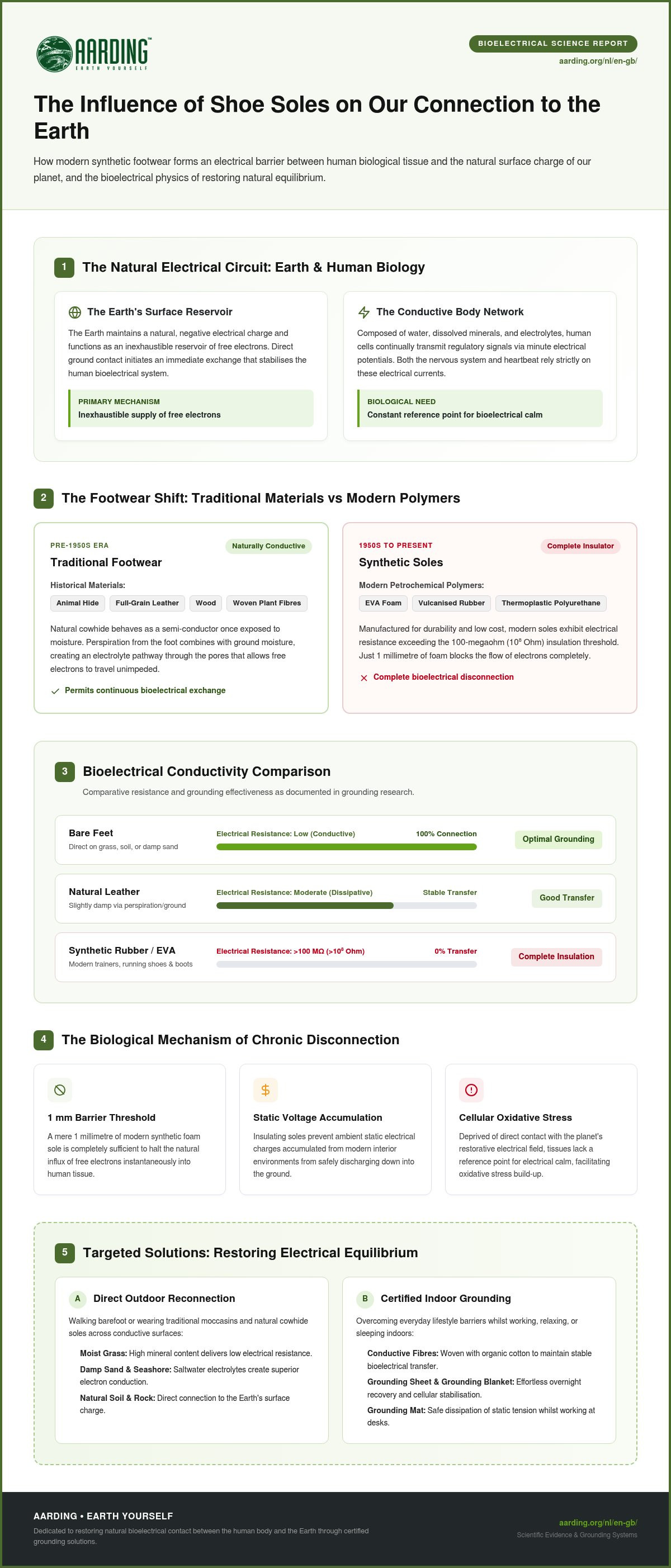
Overcoming physical insulation does not require complicated routines. Once you appreciate how the influence of shoe soles on our connection to the earth works, you can re-establish bioelectrical contact every day through considered choices. A straightforward step-by-step approach allows you to weave this effortlessly into your daily schedule:
Not every surface conducts electrical charge equally well. Moisture-rich sand along the shoreline and morning dew-covered grass make exceptional conductors due to their dissolved minerals and hydrogen bonding. Unpainted, unsealed concrete resting directly on the ground also conducts free electrons because it draws and retains moisture from the soil beneath. By contrast, dry tarmac is a petrochemical product that acts as an insulator, as do wooden decking or dry gravel. If you walk barefoot, always keep an eye out for sharp pebbles, thistles, or glass to ensure a safe experience.
Do you wish to keep your feet protected outdoors whilst remaining grounded? Minimalist footwear featuring untreated natural cowhide soles provides an excellent solution. Furthermore, specialist shoes are available that incorporate conductive carbon or copper plugs extending right through the sole.
You can easily verify the conductivity of such footwear yourself using a digital multimeter set to measure resistance in Ohms. Place one probe on the footbed inside and press the other against the tread underneath. If the device displays low resistance, charge flows readily through the sole. Should the display indicate infinite resistance, the shoe completely blocks all electron flow.
Naturally, modern urban living presents practical barriers. Cold weather, paved streets, and demanding work routines make walking barefoot daily unrealistic for many. If you wish to incorporate this natural balance into your everyday routine without losing time, discover how certified grounding products from Aarding allow you to connect with the earth with ease, right whilst you unwind or work.
The reality of modern life is that the majority of our time is spent indoors. Fitted carpets, laminate, and concrete floor slabs combine with our shoes to form an uninterrupted barrier. Those wishing to offset the influence of shoe soles on our connection to the earth during the daytime do not need to overhaul their lifestyle completely. Thoughtfully engineered indoor systems offer a natural way to supply the body with free electrons indoors.
These systems plug securely into the earthing port of a standard domestic wall socket. They connect exclusively to the metal earth pin, which links directly to an earthing rod positioned deep in the soil outside. No mains electricity runs through the system; it acts purely as a conductive channel that safely carries the subtle charge of the Earth into your home.
Your time in bed offers the optimal window for profound physical restoration. For seven to eight hours, your body rests in one fixed position, enabling uninterrupted bioelectrical contact without any effort on your part.
A soft grounding sheet, woven with fine silver threads and sustainable organic cotton, feels just as comfortable as conventional luxury bed linen. Whilst you rest, the textile's silver fibre structure maintains direct skin contact. This helps regulate the circadian rhythm and neutralises static voltage built up throughout your day.
During a long working day behind a desk, you are encircled by computer screens, laptops, printers, and cabling. These electrical appliances generate alternating electric fields that can affect your wellbeing. A versatile grounding mat provides targeted assistance here:
In this way, you combine indoor comfort with the fundamental stability of the Earth's surface. Explore the extensive range at Aarding to find your ideal indoor grounding solution.
The influence of shoe soles on our connection to the earth is undeniable: synthetic polymers insulate our bodies from the health-supporting flow of free electrons. This persistent absence of bioelectrical discharge can fuel subtle tension and chronic fatigue. Fortunately, restoring harmony requires no radical shift. By consciously walking barefoot across damp grass more often or opting for conductive leather footwear, you restore your cells' physiological resting state immediately.
Because everyday modern life does not always permit hours of barefoot wandering outdoors, dedicated indoor solutions provide the perfect alternative. Since 2012, Aarding has been the premier trusted specialist in high-calibre grounding products across Europe. Thanks to thoroughly tested, safe systems crafted from premium materials such as conductive silver fibre and breathable organic cotton, you can recharge your body effortlessly whilst you sleep or work. Discover how to restore your natural balance with restorative products from Aarding and experience the profound calm of a grounded lifestyle for yourself.
Yes, modern rubber and synthetic soles represent the primary cause of this widespread physical disconnection. Polymer compounds such as vulcanised rubber and synthetic foam feature an exceptionally high electrical resistance, completely preventing electrons from passing through. Because of this, the influence of shoe soles on our connection to the earth is decisive in daily life: the moment you put on shoes with synthetic soles, you instantly break your natural contact with the electrical charge of the Earth's surface.
Yes, footwear featuring untreated soles made from natural leather does indeed facilitate grounding, provided the leather is slightly damp. Leather is a porous natural material that absorbs foot perspiration and moisture from the ground. The mineral salts contained within this moisture form a conductive bridge for free electrons. Do make certain that the sole consists entirely of pure leather, without intervening layers of synthetic foam or cemented rubber outsoles.
Walking barefoot across wooden flooring or laminate does not ground you. Both finished timber floorboards and synthetic laminate possess high insulation ratings and are structurally elevated above the building's earth foundations. Even in bare feet, you remain bioelectrically isolated on these indoor surfaces. Only unsealed stone tiles or a concrete floor poured directly onto the earth below can permit electrical conductivity.
You can readily test the electrical conductivity of your shoes with a digital multimeter configured to measure resistance in Ohms. Place one test probe inside the shoe against the heel area of the footbed and press the second probe against the underside of the outer sole. If the meter shows a low resistance reading, electrical charge can pass through the sole. If the display indicates infinite resistance, the shoe is fully insulating.
Yes, using a certified grounding mat in an earthed wall socket is entirely safe. The plug only establishes physical contact with the external metal earth pin and does not engage with the live electrical sockets. As a result, no mains current travels through the product and zero electricity is consumed. The equipment acts strictly as a conductive conduit for the Earth's natural electrical potential.
A daily barefoot session lasting twenty to thirty minutes on damp grass or wet sand delivers noticeable biological discharge to your system. Within this timeframe, your bioelectrical potential stabilises and your physiology absorbs free electrons. Since the influence of shoe soles on our connection to the earth persists throughout the rest of your day, making this a regular daily habit offers the most consistent support for biological balance.
Certainly; you can remain continuously grounded throughout the winter without subjecting your feet to freezing temperatures. Indoor options such as a grounding sheet crafted from organic cotton and silver fibre, or a soft grounding blanket, allow you to make comfortable, cosy contact indoors. This enables you to reap the restorative benefits of the Earth's potential effortlessly whilst sleeping or unwinding on the sofa, whatever the weather outdoors.
Comments will be approved before showing up.