Your Cart is Empty



You might think that you are protecting your valuable sheet by washing it as little as possible, but the opposite is true. It sounds contradictory, but regular washing is essential to protect the conductivity of your grounding sheet from the insulating effect of natural body oils. It is perfectly understandable that you are uncertain about when to replace grounding sheet, especially as you want to keep the delicate silver fibre in the fabric in top condition for as long as possible.
In this guide, you will discover how to maximise the lifespan of your organic cotton bedding and ensure the vital connection to the earth. We will remove the doubt about the influence of sweat and the correct washing method for your material. You will learn how to easily measure the conductivity yourself with a multimeter, so you always know for sure that your body is benefiting from the natural electron flow. This way, you genuinely support your own recovery power and enjoy the soothing benefits of an earthed life for years to come.
It might sound contradictory. You want to keep your valuable sheet looking good for as long as possible, so you are careful with the washing machine. Yet, regular washing is the most important action to maintain the function of your grounding sheet. The silver fibre in the fabric is not a passive component; it is an active conductor that needs a direct, pure connection with your skin for optimal results.
When you sleep, your body performs a natural recovery process. This releases sweat, sebum, and skin cells. Even if you shower before bed, your skin produces natural oils. These substances are naturally insulating. They form a wafer-thin film over the silver fibre, hindering the flow of electrons. This is why many people wonder when to replace grounding sheet becomes necessary; often, a consistent wash is the solution before replacement is truly needed.
The combination of soft organic cotton and silver fibre is designed to work in harmony. The cotton absorbs moisture and offers comfort, whilst the silver maintains the connection to the earth. If you postpone washing, body oils penetrate deep into the fibres and can eventually cause the silver to oxidise. A paradoxical effect arises: by not washing, your sheet wears out faster than with a weekly wash in the washing machine.
Silver is one of the best conducting materials on our planet. In your sheet, these silver fibres are closely interwoven with the durable organic cotton. This structure ensures that, regardless of your sleeping position, you always make contact with the earthing network. This process relies on the concept of earthing, where the negative charge of the earth helps to support the natural balance in your body. For a constant flow of these electrons, however, the surface of the fibres must remain free of blockages. A clean sheet is therefore not just a matter of hygiene; it is a technical requirement for your well-being.
The insidious thing about skin oils and body lotion residues is that you often do not see them with the naked eye. Your sheet may still look fresh after a week, whilst its conductivity is already quietly diminishing. This invisible layer acts as a kind of barrier around the silver fibre. If this layer becomes too thick or remains for too long, the acids in your sweat can corrode the silver. This accelerates the oxidation process, causing the fibre to eventually lose its strength. Understanding this process helps you determine when to replace grounding sheet is truly necessary, or when you can significantly extend its lifespan with a careful washing routine.
Maintaining the restorative power of your bedding begins with a careful washing routine. Before placing the sheet in the machine, there is one action you must never forget: always disconnect the connection cable first. This protects both the metal press stud on your sheet and the integrity of the silver fibre in the fabric. It is a small effort that lays the foundation for a long-lasting connection to the earth.
The ideal temperature for effective cleaning is 40 degrees Celsius. This temperature is the 'sweet spot' for silver; it is warm enough to effectively remove body oils and bacteria, but cool enough not to unnecessarily stress the silver fibre. Preferably wash your sheet every one to two weeks. This regularity prevents sebum from accumulating, meaning you will less quickly have to wonder when to replace grounding sheet is the only remaining option. A clean surface guarantees that the electron flow reaches your body unimpeded, which is essential for the results described in scientific research on grounding.
The choice of your detergent largely determines how long the silver fibres remain active. Use only a neutral, liquid detergent. Avoid powder detergents, as these can contain abrasive particles that mechanically damage the silver fibre. It is crucial to avoid products with bleaches, chlorine, or strong enzymes; these chemical substances cause oxidation, which turns the silver black and makes it lose its conductivity. Check the pH value of your product; a neutral value is safest for your valuable organic cotton.
Choose a programme for delicate wash or a standard cotton programme, but limit the spin speed to a maximum of 800 to 1000 revolutions. Spinning too hard pulls at the fibres and can cause the fine silver fibre to break. If possible, add an extra rinse cycle to your programme. This ensures that all soap residues are completely removed. In areas with hard water, limescale can adhere to the fibres; an extra rinse helps to minimise this. Should you notice that your current sheet feels less supple despite good care, then a new Earthing Fitted Sheet might be a valuable investment in your night's sleep.
You can safely wash your grounding sheet together with other soft fabrics, such as towels or other cotton bedding. However, make sure that there are no garments with sharp zips, hooks, or Velcro in the same drum. These can damage the delicate weave of the silver. By consistently following these steps, you postpone the moment when to replace grounding sheet becomes necessary and you optimally enjoy the natural peace that earthing offers.
To ensure the integrity of your grounding sheet, you must resolutely keep certain everyday household products away from your washing machine. Some substances react chemically with the silver fibre, whilst others form a physical barrier that blocks the energetic exchange. It is often through the unconscious use of these forbidden agents that the question when to replace grounding sheet becomes relevant sooner than you would like. Good preparation prevents you from accidentally insulating the valuable silver fibres.
A common pitfall is 'natural' or ecological detergents. Whilst these are often better for the environment, they regularly contain essential oils such as lavender, eucalyptus, or coconut oil for a pleasant scent. For your grounding sheet, these oils are just as harmful as the synthetic variants. They leave a film on the fibre that gradually reduces conductivity. Aggressive stain removers and sprays are also out of the question; they affect the structure of the organic cotton and can literally eat away at the thin silver fibre.
Fabric softener is the biggest enemy of any earthing product. Whilst it makes your organic cotton feel wonderfully soft, it leaves a microscopically small, greasy layer on the silver fibres. This layer acts as a perfect insulator. The electrons from the earth simply cannot penetrate this barrier to your skin. Damage from fabric softener is often irreversible in the long term because the conditioners embed themselves deep in the pores of the fibre. Do you still want to keep your sheet extra soft? Then use a dash of natural vinegar in the fabric softener compartment; this removes limescale without affecting conductivity.
Your personal care ritual has a direct impact on the lifespan of your material. Many night creams and body lotions contain oils that can 'suffocate' the silver fibre. Wait at least an hour after applying before making contact with your sheet. This gives your skin time to fully absorb the products. Be extra vigilant with products containing sulphur or chlorine; these significantly accelerate the oxidation of silver. If you notice that the fabric becomes stiff or that the fibre shows dark discolourations that no longer disappear after a wash, that is an important signal for when to replace grounding sheet is the only way to experience the full therapeutic effect of earthing again.
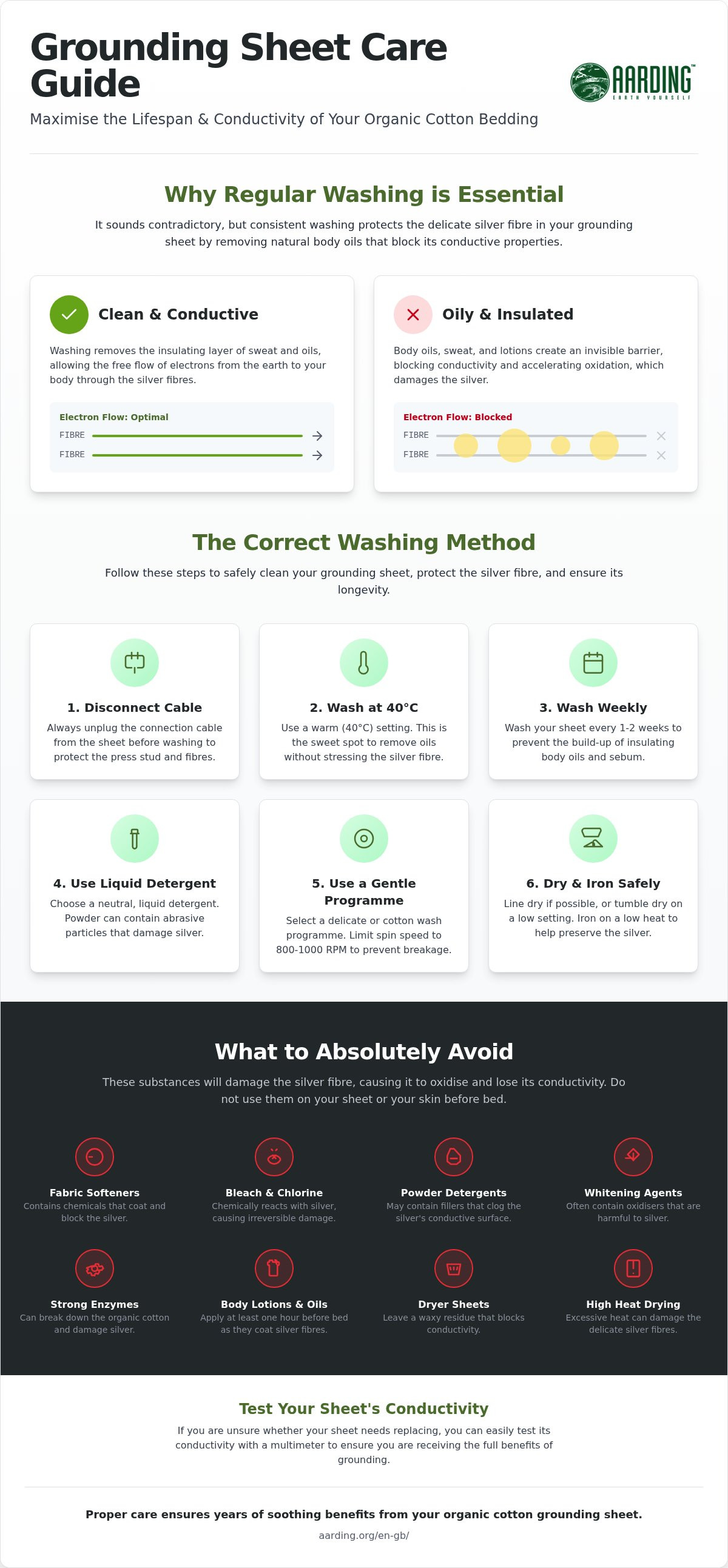
Caring for your sheet does not stop once the washing machine is finished. The way you dry and treat the fabric is crucial for the lifespan of the subtle silver fibre woven through the organic cotton. Heat and friction are the most important factors to consider. By consciously choosing mild methods, you preserve the energetic integrity of the material and promote an undisturbed night's sleep. Insight into these details helps you determine when to replace grounding sheet is the only remaining step, but with the correct drying method, you will postpone that moment for years.
The most natural and safe way to dry your sheet is by air. Preferably hang the sheet indoors or in the shade. Whilst drying outdoors is wonderfully fresh, direct and strong sunlight can unnecessarily stress the silver fibre in the long run due to UV radiation. Do you still want to use the tumble dryer? Only do this at a very low temperature. Too much heat causes heat stress in the fibres, which can lead to shrinkage of the cotton and brittleness of the silver. Under no circumstances use dryer sheets. These sheets, like fabric softeners, leave an oily layer that directly blocks conductivity.
Ironing a grounding sheet is usually not necessary if you hang the sheet taut immediately after washing. Should you still want to iron it for a smoother result, do so at a low temperature setting, specifically set for delicate fabrics or synthetic fibres. Extreme heat accelerates the oxidation rate of the silver, causing the fibre to dull faster and lose its strength. Steam ironing is often a safer choice than dry ironing, as the moist heat is less aggressive for the weave. This keeps your sheet supple and functional.
When you travel and want to take your trusted earthing products with you, it is advisable to loosely roll up the sheet instead of folding it sharply. This prevents permanent creases that can weaken the silver fibre in the long term. Should you notice over time that the fabric becomes stiff or less effective despite all your good care, it may be time for a new one. View our full range of Earthing Fitted Sheet options to elevate your nocturnal recovery to an optimal level again.
By integrating these simple steps into your routine, you create a sustainable foundation for your well-being. You now know exactly how to preserve the quality of your organic cotton and when to replace grounding sheet is truly necessary. Careful treatment of your material is a reflection of the care for your own health.
After all the careful washes and gentle drying, you naturally want to be sure that the connection to the earth is still strong. A visual inspection of the silver fibre is a good starting point. With a new sheet, the fibres subtly shimmer through the fabric. As time passes, the colour may become slightly duller. This does not necessarily mean that the conductivity is gone, but if the fibre discolours black on a large scale or the organic cotton shows signs of wear, these are clear signals. However, the eye alone does not provide a definitive answer about the energetic function of your material.
For those who want absolute certainty, the multimeter is an indispensable instrument. This device measures the electrical resistance of the fabric and is the only way to truly substantiate its function. You will need a simple multimeter that can measure resistance in Ohms (Ω). Set the meter to the 20k Ohm setting or the lowest available resistance setting. Then place one probe on the metal connection button of your grounding sheet and firmly press the other probe onto the fabric, precisely where the silver fibre is interwoven.
A well-functioning sheet will show a clear value on the screen, indicating that the circuit is closed. If the meter continues to show a '1' or 'OL' (Open Loop), regardless of where you measure on the sheet, then the silver fibre is unfortunately no longer able to conduct electrons. This objective measurement tells you precisely when to replace grounding sheet is the right step to ensure your nocturnal recovery again. It is advisable to perform this test every six months, so you never unknowingly lose the connection to the earth.
At Aarding, we have been supplying products rooted in quality and durability since 2012. On average, a quality sheet made of organic cotton and silver fibre lasts two to three years, provided you follow the mild washing routine we discussed earlier. The exact lifespan is influenced by the acidity of your skin and the frequency of washing. When the multimeter test shows that the conductivity in the areas where you lie has disappeared, the therapeutic value of the sheet has been lost.
It is essential to remember that a grounding sheet is an item of use that directly interacts with your biology. Over time, the silver fibres lose their strength due to natural oxidation. Are you unsure about the function or condition of your product? Our expertise as a guide in earthing technology is happy to help you further. A timely decision about when to replace grounding sheet is necessary ensures that you can continue to benefit without interruption from the peace and balance that an earthed life offers. Your investment in a new sheet is ultimately an investment in the continuity of your own well-being.
Caring for your bedding is an essential part of your personal well-being routine. We have seen that the lifespan of your grounding sheet largely lies in your own hands. By adhering to a mild washing routine at 40 degrees and resolutely saying goodbye to insulating fabric softeners, you protect the vital silver fibre in the fabric. Using a multimeter gives you ultimate peace of mind and certainty about the condition of your material, so you know exactly when to replace grounding sheet is the right step to ensure your nocturnal recovery.
Since 2012, Aarding has been the trusted expert in the Netherlands and Belgium for anyone striving for a holistic approach to health. Our high-quality organic cotton products are designed for years of intensive use, so you can return to the basis of your human biology every night. Should your current sheet need replacing after a period of loyal service, we invite you to discover the quality of our latest collection. View our collection of organic cotton grounding sheets on Aarding.org and restore your connection to the natural restorative power of the earth. Sleep soundly and wake up in balance every day.
Ideally, wash your grounding sheet every one to two weeks for the best results. This is essential because natural body oils, sebum, and sweat would otherwise accumulate on the silver fibre. By washing regularly, you remove this insulating layer and maintain optimal conductivity. It is a misconception that less washing extends the lifespan; it is precisely keeping the fibres clean that ensures you will less quickly have to determine when to replace grounding sheet is the only option.
Yes, you can safely wash your grounding sheet together with towels or other cotton bedding. However, make sure the drum is not too full and that there are no sharp objects such as zips or hooks that could damage the fine silver fibre. Washing with other soft organic cotton fabrics even helps to regulate friction in the machine, which benefits the lifespan of your product.
If you accidentally used fabric softener, it is important to immediately re-wash the sheet two to three times with a mild, liquid detergent. Fabric softeners leave a greasy layer on the silver fibre that blocks conductivity. By washing correctly multiple times in a row, you have a good chance of removing this layer. Always test with a multimeter afterwards to see if the conductivity has been restored before using the sheet again.
You can iron a grounding sheet, but always do so at a low temperature setting. Choose the 'synthetic' or 'silk' setting to prevent the silver fibre from being damaged by extreme heat. Steam ironing is preferred over dry ironing, as the moist heat is milder for the weave of the organic cotton. A sheet without creases is more comfortable, but always be careful with the temperature setting of your iron to protect the fibres.
Bleach and chlorine are forbidden because they react aggressively with the silver fibre. This process, called oxidation, destroys the conductive properties of the silver and makes the fibres brittle. You will see that the silver turns black or dull, which is often irreversible. To avoid having to prematurely decide when to replace grounding sheet is necessary, it is better to pre-treat stains with a mild, natural soap without bleaches.
Yes, it is advisable to wash your new grounding sheet before first use. During the production process and transport, tiny residues of substances or dust may remain in the weave. A first wash at 40 degrees opens the fibres of the organic cotton and ensures that the silver fibre can make optimal contact with your skin immediately. This way, you begin your earthing journey with a completely clean and optimally conductive surface for deep recovery.
Aarding recommends using a neutral, liquid detergent that is free from bleaches and fabric softeners. Brands such as Ecover or Seepje often offer mild variants that are safe for delicate fabrics. The most important thing is that the product does not contain strong enzymes or oils that can leave a film over the silver fibre. A simple, liquid colour detergent without additives is usually the safest and most effective choice for your valuable earthing material.
It is better not to use a specific silver-ion programme, but to choose a standard programme for delicate wash. These special programmes often use techniques that are not specifically tailored to the physical silver fibre woven into your sheet. A normal wash at 40 degrees with a low spin speed is more than sufficient to clean your grounding sheet. Trust in the simplicity of a mild wash cycle to preserve the natural restorative power of your product for years.
Comments will be approved before showing up.